

Mud from rivers into the oceans
Moderator: Community Team
Forum rules
Please read the Community Guidelines before posting.
Please read the Community Guidelines before posting.
Re: Mud from rivers into the oceans
Well God is all-encompasing, so everything is within the realm of God.

Re: Mud from rivers into the oceans
That gives me an idea for a thread, which will likely make as many theists as atheists groan when they start reading.mrswdk wrote:Well God is all-encompasing, so everything is within the realm of God.

==================================================
This post was sponsored by Far-Q Industries.
Far-Q Industries: Telling you where to go since 2008.
This post was sponsored by Far-Q Industries.
Far-Q Industries: Telling you where to go since 2008.
-
universalchiro

- SoC Training Adviser
- Posts: 562
- Joined: Thu Jul 07, 2011 10:41 am
- Gender: Male
- Location: Texas
Re: Mud from rivers into the oceans
1.crispybits wrote: 1) Is there any positive evidence that the continents ever moved as quickly as you suggest that cannot be explained easily by the current model?...( No trails of sediment across ocean floors does not count, that is negative evidence and can be explained easily by the current model). Similar for the perceived shortage of sediment at the mouths of rivers. The way science works is that you present your hypothesis, and then you present the evidence you think supports it. Not the evidence that you think disproves something else and then assume that your model must therefore be true. (I could, for example, present a number of problems with viewing duck billed platypus as a mammal, most obvious of which would be that it lays eggs. I cannot use those problems to assert that it is a reptile, for that I need positive evidence that it would fit that classification.)
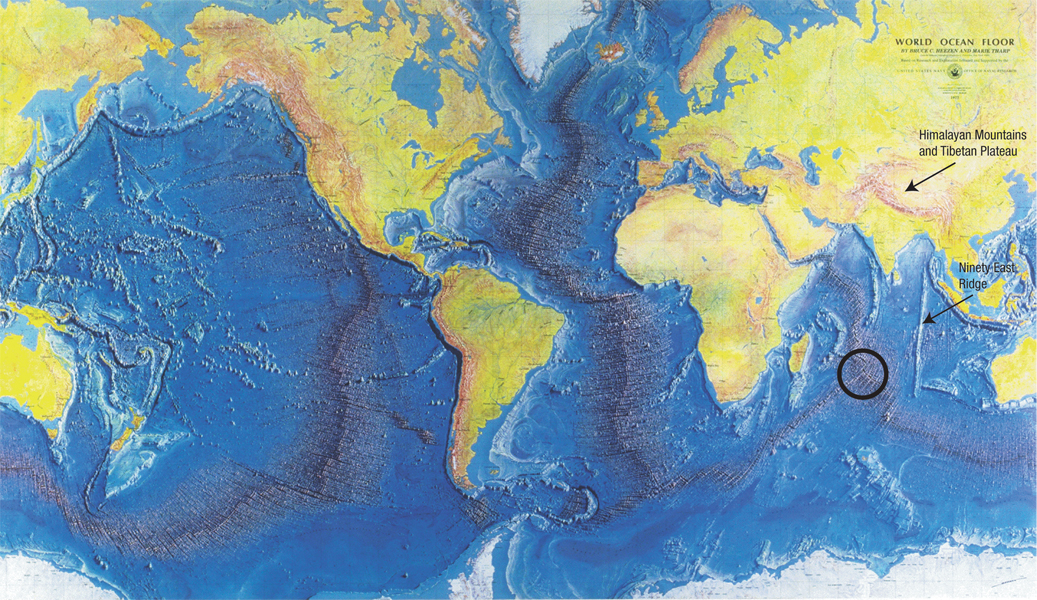
The image clearly shows the lack of sediment. It is completely valid to say a hypothesis, in this case 120 million years from Pangaea, is invalid from arguing the absence of something. For example: I've presented evidence that proves there is no sediment along the ocean floor from the mouths of Amazon/Mississippi/Congo/Nile/etc. Not only does this evidence disprove that Pangaea broke apart 120 million years ago, it also at the same time proves that the tectonic plates that carried the continents broke apart quickly. Why? Because the tectonic plates carrying the continents are moving at 1.5 inches per year. At this rate, sediment deposits occur and deltas have formed. but there is not enough sediment greater than 4500 years. And there is no trail of sediment. So at this current speed of movement, sediment is deposited. But not a trail. Not only does this disprove 120 million year old break apart of Pangaea, but at the same time it proves quick movement.
Now I agree with you that disproving evolution, does not be default prove God. On that note, is your premise of "don't disprove one thing and by default prove another", and I agree with you. This is different, I'm not saying this proves God, I'm saying this proves that the tectonic plates moved quickly recently. Hence no trail of sediment and now we do have deltas, but only 4500 years worth of sediment.
A. I agree, rivers are chaotic, mouths change, but not 1,000s of miles. The satellite images reveal that deltas expand over large areas indicating the deltas modify from time to time. but taking the sum, still is roughly 4500 years of sediment...B. I don't. Some sediment drifts off with the current, some stays in the river. I'm utilizing the scientist's research and their numbers as the rate of deposit from the rivers to their deltas. It's their numbers and they have a good grasp of the rate of deposit. Well, with the rate of deposit and looking at how much deposit is there, the isn't enough sediment to establish an age greater than roughly 4500. ...C. Agreed, they have erosion. But same answer as B. I'm using the scientist's numbers and rate of deposit, including erosion values. ...crispybits wrote:2) A. River mouths are chaotic.... B. why do you assume that all of the sediment will settle out of the water there?... C. do you not accept that coastlines, including river mouths, are subject to erosion..?
Someone argued that the new sediment has buried 199.9 million years of prior sediment and this is why there is only 4500 years worth of sediment at each river. come on this is silly logic. The weight of the sediment flowing from the rivers is not dense enough to push older sediment deep into the earth. Please remember that the ocean water has a density of 1035kg/m3 and this creates a buoyancy effect.
-
crispybits

- Posts: 942
- Joined: Sun Feb 05, 2012 4:29 pm
Re: Mud from rivers into the oceans
Again - you're ONLY saying "this and this are not here", there is no positive evidence here, only negative. I want actual positive evidence of fast moving continents, something real and observable that cannot be explained under the current slow moving model. The only thing I've seen on creationist sites google took me to whilst researching previous posts that even approaches that is that the continents must have been fast moving to create mountains, but we can track the peaks in the Himalayas by satellite and other techniques and show that they are still moving, Everest for example is getting taller by anything up to 6cm per year. If mountains were only created by a heavy impact, then under this model slow moving continents would not have the force required to continue to force the mountains upwards. India would not still be moving into Asia, etc.
Care to share the data source you are getting your river sediment numbers from? Because I have more than a slight suspicion you are taking the claims of some creationist website at face value, and either that site is unreferenced, or they are making significant errors in science. If I knew where your data is coming from and could take a look at their calculations it would make it easier for me to work out whether to take your posts seriously or to point out where these errors are. Thus far you have not provided any references to any data or studies, we only have your unreferenced and unsubstantiated claims, which given your arguments in this thread I am completely unwilling to take on trust to be honest. Just a link or several links will do, I know what your argument is I just want the same access to the numbers it is based on as you apparently have.
Care to share the data source you are getting your river sediment numbers from? Because I have more than a slight suspicion you are taking the claims of some creationist website at face value, and either that site is unreferenced, or they are making significant errors in science. If I knew where your data is coming from and could take a look at their calculations it would make it easier for me to work out whether to take your posts seriously or to point out where these errors are. Thus far you have not provided any references to any data or studies, we only have your unreferenced and unsubstantiated claims, which given your arguments in this thread I am completely unwilling to take on trust to be honest. Just a link or several links will do, I know what your argument is I just want the same access to the numbers it is based on as you apparently have.
-
universalchiro
- SoC Training Adviser
- Posts: 562
- Joined: Thu Jul 07, 2011 10:41 am
- Gender: Male
- Location: Texas
Re: Mud from rivers into the oceans
I see no one living in Antarctica, I hear of no living in Antarctica, its too cold to live in Antarctica. therefore via absence there is no one living in Antarctica.
A negative argument is a valid method. You have not proved my hypothesis wrong & I've given clear evidence to debunk the current hypothesis that Pangaea broke apart 120 million years ago, and tectonic plates moved quickly in the beginning and slow within the last 4500 years. This is why we have deltas of 4500 years old and no trail.
Whether you won't see the logic or can't see the logic, the evidence stands on its own as a testimony.
A negative argument is a valid method. You have not proved my hypothesis wrong & I've given clear evidence to debunk the current hypothesis that Pangaea broke apart 120 million years ago, and tectonic plates moved quickly in the beginning and slow within the last 4500 years. This is why we have deltas of 4500 years old and no trail.
Whether you won't see the logic or can't see the logic, the evidence stands on its own as a testimony.
Re: Mud from rivers into the oceans
Is this a vague reference to my posts on rock formation? UC, are you just blithely ignoring my posts because they contain inconvenient information and references?universalchiro wrote:Someone argued that the new sediment has buried 199.9 million years of prior sediment and this is why there is only 4500 years worth of sediment at each river. come on this is silly logic. The weight of the sediment flowing from the rivers is not dense enough to push older sediment deep into the earth. Please remember that the ocean water has a density of 1035kg/m3 and this creates a buoyancy effect.
I don't care about the absence of sediment older than 4,500 because it proves NOTHING. Sediment at the bottom of a body of water is subjected to the weight of all the water on top of it, including the atmosphere atop the water as well. The absence of sediment older than 4,500 on the ocean floor is not unexplained phenomena. It is covered by rock formation as well as subduction zones between tectonic plates.
Either bring up something new or poke holes in rock formation and/or thermodynamics. Because right now you're just repeating yourself like a broken record; can't find any sediment older than 4,500 years, can't find any sediment older than 4,500 years, can't find any sediment older than 4,500 years, can't find any sediment older than 4,500 years, ad nauseum.
==================================================
This post was sponsored by Far-Q Industries.
Far-Q Industries: Telling you where to go since 2008.
This post was sponsored by Far-Q Industries.
Far-Q Industries: Telling you where to go since 2008.
-
Metsfanmax

- Posts: 6722
- Joined: Wed Apr 11, 2007 11:01 pm
- Gender: Male
Re: Mud from rivers into the oceans
How could the flood have broken apart the continents?universalchiro wrote:The hypothesis is that at the time of creation there was Pangea. This is represented by God on the 3rd day of creation gathering the waters into one place. Which means the dry land would be in the other one place. ie Pangea. Genesis 1. (3rd day), some 6,000 years ago.Metsfanmax wrote:Biblical historians seem to agree that the Earth is approximately 6,000 years old. Why would there only be 4,500 years' worth of deposits then?universalchiro wrote: So ask yourself, if the continents are 120 million years old, wouldn't there be a delta of sediment build up that exceeds 5,000 years? If you can't find such a delta, then one should reevaluate the 120 million years of age. And not to 119 million years of age, but far far younger than you are comfortable with. ie young as in accord with the Bible.
(I don't know enough about this topic to comment on the science, unfortunately.)
Water burst out of the earth (Genesis 7:11) for 40 days and it rained for 40 days, global flood. This catastrophic event broke apart Pangea to individual continents, roughly 4,500 years ago. This is why there is only enough sediment deposits at the deltas of rivers to support young rivers. Otherwise, the gulf of Mexico would potentially filled in by now after 120 million years of deposits. And with slow moving continents, the ocean floor would have a trail leading back to where the rivers started with a fanned out line leading from the mid-Atlantic ridge to the river delta.
Thoughts?
-
universalchiro
- SoC Training Adviser
- Posts: 562
- Joined: Thu Jul 07, 2011 10:41 am
- Gender: Male
- Location: Texas
Re: Mud from rivers into the oceans
You don't understand buoyancy force. I understand why you have your premise of 4500 years of sediment has buried 199.9 million years of deposits. You are respectfully not understanding the physics involved & this may explain why you're not understanding the evidence. This is why I'm repeating myself.Artimis wrote:I don't care about the absence of sediment older than 4,500... Sediment at the bottom of a body of water is subjected to the weight of all the water on top of it, including the atmosphere atop the water as well......universalchiro wrote:Someone argued that the new sediment has buried 199.9 million years of prior sediment and this is why there is only 4500 years worth of sediment at each river. come on this is silly logic. The weight of the sediment flowing from the rivers is not dense enough to push older sediment deep into the earth. Please remember that the ocean water has a density of 1035kg/m3 and this creates a buoyancy effect.
-
crispybits
- Posts: 942
- Joined: Sun Feb 05, 2012 4:29 pm
Re: Mud from rivers into the oceans
Antarctica's average daily temperature of -40 (or something around that) is positive evidence that no human lives there (facetious comments about the small handful of scientists that live in research stations aside - I assume we're talking about a native human population). It took until the last couple of centuries before we had the equipment necessary to survive in those conditions.universalchiro wrote:I see no one living in Antarctica, I hear of no living in Antarctica, its too cold to live in Antarctica. therefore via absence there is no one living in Antarctica.
A negative argument is a valid method. You have not proved my hypothesis wrong & I've given clear evidence to debunk the current hypothesis that Pangaea broke apart 120 million years ago, and tectonic plates moved quickly in the beginning and slow within the last 4500 years. This is why we have deltas of 4500 years old and no trail.
Whether you won't see the logic or can't see the logic, the evidence stands on its own as a testimony.
I would do more to prove your hypothesis wrong, but you're not providing your data. Without that your hypothesis is nothing more than an assertion, and we can continue to do as you have done for the last 16 pages and just repeat ourselves ad nauseam without providing any actual evidence, or you could show us the calculations this is based off. That's another way science works, people don't just say "I reckon THIS" and that's the end of that. they say "I reckon THIS and here's my data" and other people get to check it and see if whatever their claim is holds water. So please, show us the data you are basing your assertion from. If that's a creationist website then that's no problem, as long as they have referenced proper peer reviewed scientific papers themselves. I don't mind following a short trail to get back to the basis of your claim.
(By the way (and I can show the maths for this if you want) if only 50% of the sediment carried by the Amazon settled in the delta, the land mass at the river mouth would expand by roughly 20km in each direction into the Atlantic every year, and at that rate it would only take around 150 years before it joined up with Africa. So I'm curious to see what percentage of the sediment is being claimed to be settling each year under your model.)
-
BigBallinStalin

- Posts: 5151
- Joined: Sun Oct 26, 2008 10:23 pm
- Location: crying into the dregs of an empty bottle of own-brand scotch on the toilet having a dump in Dagenham
- Contact:
Re: Mud from rivers into the oceans
Well, that's why the land inside South America is shrinking. In 100 years, there will be a giant lake almost the size of Brazil in the middle of South America. I'd show you my data, but no I won't.crispybits wrote: (By the way (and I can show the maths for this if you want) if only 50% of the sediment carried by the Amazon settled in the delta, the land mass at the river mouth would expand by roughly 20km in each direction into the Atlantic every year, and at that rate it would only take around 150 years before it joined up with Africa. So I'm curious to see what percentage of the sediment is being claimed to be settling each year under your model.)
-
crispybits
- Posts: 942
- Joined: Sun Feb 05, 2012 4:29 pm
Re: Mud from rivers into the oceans
Do you actually want to see the data BBS? 6300km3/year is from the powerpoint thingy I linked earlier. I suspect it's actually eroding far less volume than that from rocky areas that are very dense, and by the time it gets down river because it's fine particles it takes up more space (much like 1 ton of sand has a much higher volume than 1 ton of sandstone). Most of the sediment is likely organic matter picked up on the journey through the rainforest which actually replenishes the land mass as trees pull carbon from the air (nearly two thirds of the sediment volume removed can be replaced just by carbon capture from the Amazon rainforest, let alone other areas of plant mass or other processes)

Re: Mud from rivers into the oceans
I see no deity,I hear no credible evidence for one,homo sapiens have active imaginations,therefore by absence there is no deity...lol.universalchiro wrote:I see no one living in Antarctica, I hear of no living in Antarctica, its too cold to live in Antarctica. therefore via absence there is no one living in Antarctica.
A negative argument is a valid method. You have not proved my hypothesis wrong & I've given clear evidence to debunk the current hypothesis that Pangaea broke apart 120 million years ago, and tectonic plates moved quickly in the beginning and slow within the last 4500 years. This is why we have deltas of 4500 years old and no trail.
Whether you won't see the logic or can't see the logic, the evidence stands on its own as a testimony.
-
universalchiro
- SoC Training Adviser
- Posts: 562
- Joined: Thu Jul 07, 2011 10:41 am
- Gender: Male
- Location: Texas
Re: Mud from rivers into the oceans
This is an indictment of the dogmatic indoctrination of some evolutionist that are closed minded that they will attempt to prove any hypothesis wrong if it goes against any premise of their belief system, even though the evidence is clear as day right before their eyes.crispybits wrote:I would do more to prove your hypothesis wrong, but you're not providing your data..)universalchiro wrote:I see no one living in Antarctica, I hear of no living in Antarctica, its too cold to live in Antarctica. therefore via absence there is no one living in Antarctica.
A negative argument is a valid method. You have not proved my hypothesis wrong & I've given clear evidence to debunk the current hypothesis that Pangaea broke apart 120 million years ago, and tectonic plates moved quickly in the beginning and slow within the last 4500 years. This is why we have deltas of 4500 years old and no trail.
Whether you won't see the logic or can't see the logic, the evidence stands on its own as a testimony.
Those who scream tolerance and say creationist are so intolerant, are often the first ones to dogmatically adhere to their beliefs in the face of all evidence that shows they are wrong.
Very sad, but anticipated.


Re: Mud from rivers into the oceans
You're misunderstanding how science works again. Scientists examine EVERY hypothesis critically. It isn't as if Darwin published The Origin of Species and scientists collectively skimmed through the foreword, shrugged their shoulders and accepted it as truth.universalchiro wrote:This is an indictment of the dogmatic indoctrination of some evolutionist that are closed minded that they will attempt to prove any hypothesis wrong if it goes against any premise of their belief system, even though the evidence is clear as day right before their eyes.crispybits wrote:I would do more to prove your hypothesis wrong, but you're not providing your data..)universalchiro wrote:I see no one living in Antarctica, I hear of no living in Antarctica, its too cold to live in Antarctica. therefore via absence there is no one living in Antarctica.
A negative argument is a valid method. You have not proved my hypothesis wrong & I've given clear evidence to debunk the current hypothesis that Pangaea broke apart 120 million years ago, and tectonic plates moved quickly in the beginning and slow within the last 4500 years. This is why we have deltas of 4500 years old and no trail.
Whether you won't see the logic or can't see the logic, the evidence stands on its own as a testimony.
Look, enough red herrings and non sequiturs. You made a claim. We asked you to support the claim. You repeated the claim. Do you see why we have an issue with this?
Re: Mud from rivers into the oceans
universalchiro wrote:This is an indictment of the dogmatic indoctrination of some evolutionist that are closed minded that they will attempt to prove any hypothesis wrong if it goes against any premise of their belief system, even though the evidence is clear as day right before their eyes.crispybits wrote:I would do more to prove your hypothesis wrong, but you're not providing your data..)universalchiro wrote:I see no one living in Antarctica, I hear of no living in Antarctica, its too cold to live in Antarctica. therefore via absence there is no one living in Antarctica.
A negative argument is a valid method. You have not proved my hypothesis wrong & I've given clear evidence to debunk the current hypothesis that Pangaea broke apart 120 million years ago, and tectonic plates moved quickly in the beginning and slow within the last 4500 years. This is why we have deltas of 4500 years old and no trail.
Whether you won't see the logic or can't see the logic, the evidence stands on its own as a testimony.
Those who scream tolerance and say creationist are so intolerant, are often the first ones to dogmatically adhere to their beliefs in the face of all evidence that shows they are wrong.
Very sad, but anticipated.
No,no,no,the scientific method attempts to prove all hypotheses wrong,thats how people win Nobel prizes.It's always a work in progress,there are no final answers,just the latest one's.Einstein improved on Newton who improved on Aristotle and so on.
If your mind craves certainty,avoid science,they are incompatible..
-
universalchiro
- SoC Training Adviser
- Posts: 562
- Joined: Thu Jul 07, 2011 10:41 am
- Gender: Male
- Location: Texas
Re: Mud from rivers into the oceans
No no no. You've missed the point. Its not wise to approach a hypothesis or data with a preconceived belief its wrong. That's not scientific, scientist are by definition to be open minded.
Re: Mud from rivers into the oceans
I understand the physics just fine, What I can't understand is why you're fixating so hard on the sediment issue to the point that you're ignoring basic physics. Such as the obvious increased density water relative to air and of dirt relative to water. Water is roughly 20 times denser than air, dirt is roughly 2 times denser than water(there is some variability due to local weather conditions and altitude, which scales for all materials involved). Thus the dirt will sink through the air and water until it comes to a rest.universalchiro wrote:You don't understand buoyancy force. I understand why you have your premise of 4500 years of sediment has buried 199.9 million years of deposits. You are respectfully not understanding the physics involved & this may explain why you're not understanding the evidence. This is why I'm repeating myself.
Fine grain material that is laid down by wind as explained by the link in hotfire's post can continue to accumulate for tens of thousands of years because the dirt and atmosphere by themselves are not heavy enough to compress the bottom most layers n a mere 4,500 years. After a sufficient amount of time passes some sedimentary rock will be formed by this process, just not quickly.hotfire wrote:here is ur river sediment from over 4500 years...
http://exhibits.museum.state.il.us/exhi ... loess.html
next topic please
Now, on the subject of water there is a handy to remember rule of thumb, for every 33 feet you descend from the surface of the water the surrounding pressure increases by 1 atmosphere. That means that not only will your ears hurt, your lungs will have their gaseous volume halved as you experience twice the atmospheric pressure that you would otherwise be subjected to on the surface. Link here: http://www.deep-six.com/page59.htm
Why is that relevant? Think about it, every 33 feet the atmospheric pressure increases by a factor of 1, at 66 feet, it's 3 atmospheres, at 99 feet it's 4 atmospheres. Now tell me, how deep is the Atlantic ocean?......
I looked on wiki, here's what I found: http://en.wikipedia.org/wiki/Atlantic_Ocean
Now lets get the calculator outOcean Floor, 1st paragraph, 4th sentence wrote:The depth of water at the apex of the ridge is less than 2,700 metres (1,500 fathoms; 8,900 ft) in most places, while the bottom of the ridge is three times as deep.
, 8,900 divided by 33 equals 269.6969(recurring), that's two hundred and sixty-nine(No sniggering at the back kids!  ) and a third atmospheres. That's just at the shallowest parts of the ridge, I'll let you work out the figure for the deepest parts, UC, can you see where I'm going with this?
 Dirt is denser than water, dirt sinks to the bottom of water, gets compressed by a shit-ton of water, dirt becomes sedimentary rock. And a good job too otherwise you wouldn't have chalk(to write on blackboards with) or limestone and sandstone(looks great on buildings) or shale(for energy companies to exploit new fossil fuel resources).
At 269 atmospheres plus, buoyancy does not even so much as count for an afterthought.
==================================================
This post was sponsored by Far-Q Industries.
Far-Q Industries: Telling you where to go since 2008.
This post was sponsored by Far-Q Industries.
Far-Q Industries: Telling you where to go since 2008.
Re: Mud from rivers into the oceans
If the hypothesis has merit the scientific method will uncover it regardless of anyone's preconceived ideas.universalchiro wrote:No no no. You've missed the point. Its not wise to approach a hypothesis or data with a preconceived belief its wrong. That's not scientific, scientist are by definition to be open minded.
-
crispybits
- Posts: 942
- Joined: Sun Feb 05, 2012 4:29 pm
Re: Mud from rivers into the oceans
Come on UC, just a link to where you got your information from. It can be the ICR for all I care, if the data is solid it doesn't matter who is presenting it. If the data is solid it doesn't matter if I go in trying to disprove it, because I won't be able to. The only two reasons you may have to hide your data source is that (a) it doesn't exist and you're just making stuff up as you go along or (b) you know it's full of easily spotted lies and bullshit. Either way that doesn't reflect well on your baseless (so far) assertions in this thread.
-
crispybits
- Posts: 942
- Joined: Sun Feb 05, 2012 4:29 pm
Re: Mud from rivers into the oceans
Oh and I had to laugh here - one word for ya - evolution.universalchiro wrote:No no no. You've missed the point. Its not wise to approach a hypothesis or data with a preconceived belief its wrong. That's not scientific, scientist are by definition to be open minded.
Re: Mud from rivers into the oceans
Evolution is certainly a laughable theory.
-
BigBallinStalin
- Posts: 5151
- Joined: Sun Oct 26, 2008 10:23 pm
- Location: crying into the dregs of an empty bottle of own-brand scotch on the toilet having a dump in Dagenham
- Contact:
Re: Mud from rivers into the oceans
Oh boy, we've reached the whining stage.universalchiro wrote:This is an indictment of the dogmatic indoctrination of some evolutionist that are closed minded that they will attempt to prove any hypothesis wrong if it goes against any premise of their belief system, even though the evidence is clear as day right before their eyes.crispybits wrote:I would do more to prove your hypothesis wrong, but you're not providing your data..)universalchiro wrote:I see no one living in Antarctica, I hear of no living in Antarctica, its too cold to live in Antarctica. therefore via absence there is no one living in Antarctica.
A negative argument is a valid method. You have not proved my hypothesis wrong & I've given clear evidence to debunk the current hypothesis that Pangaea broke apart 120 million years ago, and tectonic plates moved quickly in the beginning and slow within the last 4500 years. This is why we have deltas of 4500 years old and no trail.
Whether you won't see the logic or can't see the logic, the evidence stands on its own as a testimony.
Those who scream tolerance and say creationist are so intolerant, are often the first ones to dogmatically adhere to their beliefs in the face of all evidence that shows they are wrong.
Very sad, but anticipated.
Present your data; otherwise, you're full of shit. What "face of all evidence"? You're leaving out the citation part. Why is that?
-
AndyDufresne

- Posts: 24932
- Joined: Fri Mar 03, 2006 8:22 pm
- Location: A Banana Palm in Zihuatanejo
- Contact:
Re: Mud from rivers into the oceans
I can just imagine the doublethink that went on inside UC's head when he was taking science exams in school and/or college.
--Andy
--Andy
Re: Mud from rivers into the oceans
So as not to derail this thread, could you please start a new thread on why you think the theory of Evolution is so laughable so we can all argue in peace and quiet elsewhere without annoying other posters here?mrswdk wrote:Evolution is certainly a laughable theory.
P.S. I'll see you there when you get started.

==================================================
This post was sponsored by Far-Q Industries.
Far-Q Industries: Telling you where to go since 2008.
This post was sponsored by Far-Q Industries.
Far-Q Industries: Telling you where to go since 2008.
Re: Mud from rivers into the oceans
I was about to say I can imagine the grade too, but that's dependent on who was marking the exam papers.AndyDufresne wrote:I can just imagine the doublethink that went on inside UC's head when he was taking science exams in school and/or college.
--Andy
==================================================
This post was sponsored by Far-Q Industries.
Far-Q Industries: Telling you where to go since 2008.
This post was sponsored by Far-Q Industries.
Far-Q Industries: Telling you where to go since 2008.