Moderator: Community Team
You said the effects are already being felt.Metsfanmax wrote:China has coastlines, storms, mosquitos, politics, and water, so it is vulnerable to more or less everything I mentioned.mrswdk wrote:Okay, when will the effects be felt by people who do not live on low-lying tropical islands?Metsfanmax wrote:No, the hardcore effects of climate change have already started happening: melting ice and sea level rise, increased damage from severe weather, more spread of disease especially in tropical regions, increased political instability in vulnerable regions, drought, etc. The question now is how much worse will it get, not whether it has started yet.mrswdk wrote:Aren't the really hardcore effects of climate change only going to kick in so far into the future that we'll all be dead by then anyway?
Wrong.mrswdk wrote:This winter was just as cold as the last few. The temperature was down to -10C at the end of December, I spent a few months needing to wear base layers every time I left the apartment etc.. The only difference I noticed was that the pollution was lighter than it has been in years gone byDukasaur wrote:They are felt all the time. I'm sure there are millions of people in your country feeling them right now. You're rich and you presumably live in an air-conditioned apartment, but I'll bet there are agricultural workers in your fields right now who are feeling the heat.mrswdk wrote:Okay, when will the effects be felt by people who do not live on low-lying tropical islands?
Maybe it's only 0.3 degrees warmer today than it was on this day 10 years ago, but that 0.3 degrees, over time, has an impact on the quality of life.
I noted that your winter was ridiculously mild this year. Biting and stinging insects are probably both larger and more plentiful than normal for your rural residents this year. This too is probably something you can ignore, but some person working to grow your food will die of bee stings this year that otherwise would not have.
http://www.infowars.com/report-more-peo ... terrorism/People die of bee stings?
Yes, they are. Because China is vulnerable to the effects of global warming. Like basically every other place in the world.mrswdk wrote:You said the effects are already being felt.Metsfanmax wrote:China has coastlines, storms, mosquitos, politics, and water, so it is vulnerable to more or less everything I mentioned.mrswdk wrote:Okay, when will the effects be felt by people who do not live on low-lying tropical islands?Metsfanmax wrote:No, the hardcore effects of climate change have already started happening: melting ice and sea level rise, increased damage from severe weather, more spread of disease especially in tropical regions, increased political instability in vulnerable regions, drought, etc. The question now is how much worse will it get, not whether it has started yet.mrswdk wrote:Aren't the really hardcore effects of climate change only going to kick in so far into the future that we'll all be dead by then anyway?
Meh. It was still pretty damn cold here. I'm not gonna call that 'ridiculously mild'.Dukasaur wrote:Wrong.mrswdk wrote:This winter was just as cold as the last few. The temperature was down to -10C at the end of December, I spent a few months needing to wear base layers every time I left the apartment etc.. The only difference I noticed was that the pollution was lighter than it has been in years gone byDukasaur wrote:I noted that your winter was ridiculously mild this year. Biting and stinging insects are probably both larger and more plentiful than normal for your rural residents this year. This too is probably something you can ignore, but some person working to grow your food will die of bee stings this year that otherwise would not have.
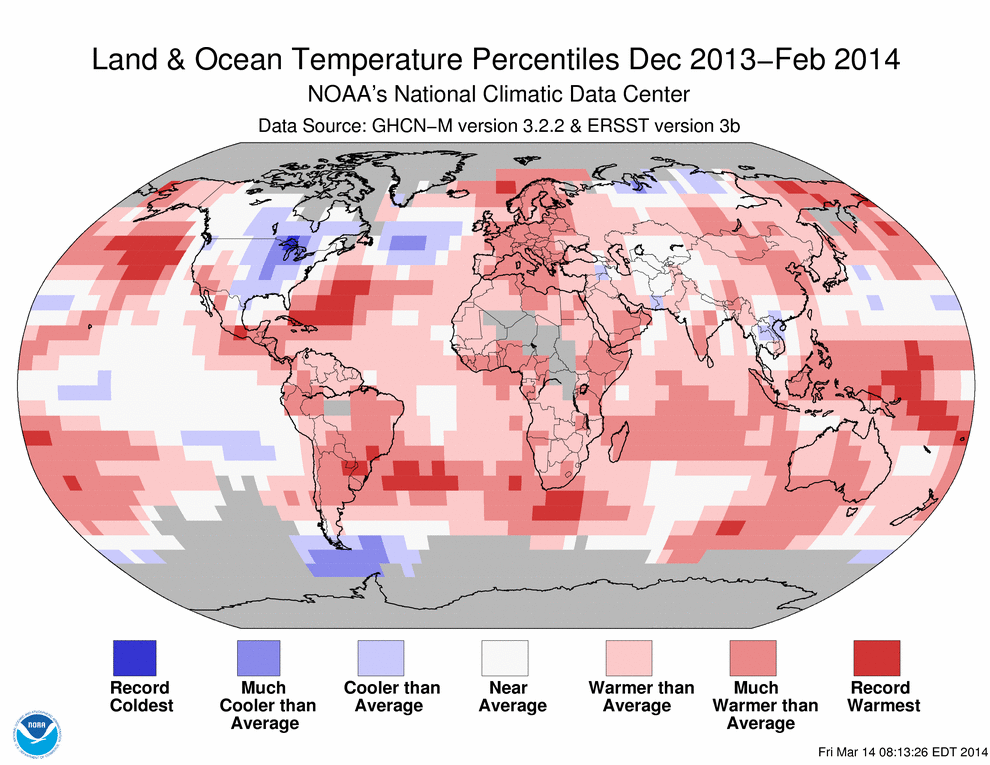
Most of China was at least 0.5 degrees warmer than average, and some of it was significantly warmer than that. The Amur region of Siberia was 5 degrees warmer than average, so I'll assume that parts of China close to the Russian border showed similar anomalies. The anomaly was less pronounced further south, but I believe you've said you're in Peking Beijing, which is definitely in the "Much Warmer than Average" belt.
This is an area where you want to trust me. I'm in the snow removal business, so from October 15th to March 31st I spend at least an hour a day looking at weather maps. Granted, 95% of those are my local weather maps, but because I care about being the best in my field, I keep tabs on what is happening in the rest of the world also.
That says, on average, 5 people per year die from hornet, wasp or bee stings in the UK.http://www.infowars.com/report-more-peo ... terrorism/People die of bee stings?
Case closed, your honor.Metsfanmax wrote:Yes, they are. Because China is vulnerable to the effects of global warming. Like basically every other place in the world.mrswdk wrote:You said the effects are already being felt.Metsfanmax wrote:China has coastlines, storms, mosquitos, politics, and water, so it is vulnerable to more or less everything I mentioned.mrswdk wrote:Okay, when will the effects be felt by people who do not live on low-lying tropical islands?Metsfanmax wrote:No, the hardcore effects of climate change have already started happening: melting ice and sea level rise, increased damage from severe weather, more spread of disease especially in tropical regions, increased political instability in vulnerable regions, drought, etc. The question now is how much worse will it get, not whether it has started yet.mrswdk wrote:Aren't the really hardcore effects of climate change only going to kick in so far into the future that we'll all be dead by then anyway?
You might want to watch out using infowars as a source. They have certain reputation.Dukasaur wrote:http://www.infowars.com/report-more-peo ... terrorism/People die of bee stings?
I googled and picked the first non-American link I came to.waauw wrote:You might want to watch out using infowars as a source. They have certain reputation.Dukasaur wrote:http://www.infowars.com/report-more-peo ... terrorism/People die of bee stings?
Look what climate change did to the Sahara, where now it is a vast desert once it was a fertile plain in a tropical region. I bet ya back then peeps were all like 'You BETTER hold in your farts! Cuz if you don't, everything will be destroyed!!' And after all these years, I remember that which matters most.....clangfield wrote:Hmm... higher agricultural yields in some places, but vegetation turned to desert in others is a likely consequence.demonfork wrote:
Increase in global temperatures has had an overall positive effect..
1. Fewer global winter deaths
2. Lower energy costs.
3. Higher agricultural yields
4. Significant growth of 31% of global vegetation over the last 3 decades. (the increase of global co2 from 0.03-0.04% has made the planet greener)
In the UK, global warming is thought to make us colder due to the gulf stream being turned south, so we'll actually get worse weather. Hence points 1 and 2 will go the other way here, and Scotland may become uninhabitable.
What is now the North Sea used to be a fertile grazing area for woolly mammoths apparently. Think on.

At least GoranZ and Oneyed have the excuse of being non-native speakers of English.Phatscotty wrote:where now it is a vast desert once it was a fertile plain in a tropical region. I bet ya back then peeps were all like 'You BETTER hold in your farts! Cuz if you don't, everything will be destroyed!!' And after all these years, I remember that which matters most.....
you are questioning my fortitude on top of all this?Metsfanmax wrote:Have you ever read a climate science journal article or IPCC report?Phatscotty wrote:I like to learn things for myself, always seeking for information, always digging deeper.
You are obviously out of the loop. There is zero question that you don't really know anything about modern climate science. The question is, do you have the intellectual fortitude to admit this to yourself?since it's possible I'm out of the loop for too long
KanyeWhen ya try hard is when ya die hard
This is sufficient. I expect that you'll presently discontinue making threads about your stance on global warming.Phatscotty wrote: Mets, my dear sweet precious sweet sweet precious, I have always had the fortitude to admit such truth.
which will happen right around the time politicians discontinue exploiting global warming to scaring the crap out of younger people in order to sucker their votes. Next time Obama makes a statement on global warming, I'm gonna say 'Are you a climate expert Mr. Obama? Oh, okay then, STFU!"Metsfanmax wrote:This is sufficient. I expect that you'll presently discontinue making threads about your stance on global warming.Phatscotty wrote: Mets, my dear sweet precious sweet sweet precious, I have always had the fortitude to admit such truth.
This thread wasn't started as a discussion about what appropriate climate policy is. It was started as a statement implying that there is not overwhelming consensus among relevant scientists about our basic understanding of global warming. If you want to discuss policy, discuss policy.Phatscotty wrote: which will happen right around the time politicians discontinue exploiting global warming to scaring the crap out of younger people in order to sucker their votes.
A very insightful statement. Maybe you should work for the politicians. They're always looking for people who are more interested in sound bites than truth seeking.lulz.... 'climate change expert' I am not climate change expert, but I can tell you that climate always has changed, and always will
This thread was started to share information I cam across, so we can learn. The policy it has to do with is 'Bullshit'. I don't have to know a single thing about the science of it all in order to detect bullshit. Here's how it looks to people who came to this earth before MetsMetsfanmax wrote:This thread wasn't started as a discussion about what appropriate climate policy is. It was started as a statement implying that there is not overwhelming consensus among relevant scientists about our basic understanding of global warming. If you want to discuss policy, discuss policy.Phatscotty wrote: which will happen right around the time politicians discontinue exploiting global warming to scaring the crap out of younger people in order to sucker their votes.
A very insightful statement. Maybe you should work for the politicians. They're always looking for people who are more interested in sound bites than truth seeking.lulz.... 'climate change expert' I am not climate change expert, but I can tell you that climate always has changed, and always will
Maybe proponents of green lifestyles aren't doing a good job of convincing those people that eco-behavior comes with enough gains to outweigh the costs, so in their minds 'eco-friendly' involves being forced to pay more.got tonkaed wrote:I guess something that has always kind of confused me to some extent is the way which people seem to really fight against the endgame of climate policy.
To me on a simple level, it seems like making businesses more efficient and homes more eco-friendly probably just ends up saving people money in the long run.
Indeed. Analyses of smart climate policy generally find negligible or even positive impact on the economy in the long run. The transition is inevitable anyway, because oil and gas are not going to get cheaper in the long run (they're finite resources and the more we drill, the harder the remainder is to obtain), whereas continued R&D in renewables and nuclear should continue to make safer, cheaper products.got tonkaed wrote:I guess something that has always kind of confused me to some extent is the way which people seem to really fight against the endgame of climate policy.
To me on a simple level, it seems like making businesses more efficient and homes more eco-friendly probably just ends up saving people money in the long run. It also seems philosophically better to be like, we took steps to try and make things better for our descendants rather than eh screw 'em.
Certainly it is a lot more complicated than that and you deal with bureaucracy and big government. It just seems like people from the get go dislike the idea of positively impacting climate change, which seems odd.
Environmentalists are often some of the worst advocates of climate policy, because almost always they're endorsing that the solution to this issue is individual behavior change, which is silly. This is a system problem, and can't be solved by a bunch of hippies not taking showers. It can only really be solved by a large-scale transition away from fossil fuels and towards renewables and nuclear. That can only happen if the price is right, and a price on carbon is therefore necessary (and economically just, given the avoided damages from a warming world).Maybe proponents of green lifestyles aren't doing a good job of convincing them that eco-behavior comes with enough gains to outweigh the costs.
The type of fuel being used is not the only issue. If all - or even just a significant number - of people stopped driving cars when they didn't need to, made their homes more energy-efficient, used less water and electricity, recycled everything that could be recycled etc., would that not have a pretty big impact by itself?Metsfanmax wrote:Environmentalists are often some of the worst advocates of climate policy, because almost always they're endorsing that the solution to this issue is individual behavior change, which is silly. This is a system problem, and can't be solved by a bunch of hippies not taking showers. It can only really be solved by a large-scale transition away from fossil fuels and towards renewables and nuclear. That can only happen if the price is right, and a price on carbon is therefore necessary (and economically just, given the avoided damages from a warming world).
Of course it would have a pretty big impact. But asking people to collectively be more altruistic is a stretch; it's hard to change human nature. I laud those who try, and indeed I constantly try to convince people to be more altruistic on a regular basis. But if you want relatively quick change in behavior, you don't get it by appealing to good intentions; you do it by making the right actions cheaper and better. The rest will follow automatically. Instead of trying to get people to drive less, make driving less harmful. The former takes millions to make an impact; the latter takes a few smart engineers at Tesla.mrswdk wrote: The type of fuel being used is not the only issue. If all - or even just a significant number - of people stopped driving cars when they didn't need to, made their homes more energy-efficient, used less water and electricity, recycled everything that could be recycled etc., would that not have a pretty big impact by itself?
We never got into it in too much detail because it is a complicated discussion to try to list all of the benefits and harms. It is also, to me, a meaningless question to ask about a global cost-benefit analysis because the costs and benefits are not shared equally among all. If a few small island nations disappear but the GDP of the US increases by 1%, that could very well be net-beneficial to the world's economic output but it would be difficult to argue that it was a just state of affairs.If BBS were here he would probably ask what benefits climate change would bring, and whether or not those outweigh the damages. Was that question ever answered on here? I forget.
It's not about altruism. Old ladies sift through my garbage to get the bottles because they can get money from recycling them. Making your home more energy efficient lowers your power bills. Same for using less water and your water bills. Driving a car becomes dumb if using a cycle lane or public transport is faster than sitting in traffic (which it almost always is - I don't understand why anyone in Beijing drives to work when rush hour traffic is so bad that the subway ends up being faster).Metsfanmax wrote:Of course it would have a pretty big impact. But asking people to collectively be more altruistic is a stretch; it's hard to change human nature. I laud those who try, and indeed I constantly try to convince people to be more altruistic on a regular basis. But if you want relatively quick change in behavior, you don't get it by appealing to good intentions; you do it by making the right actions cheaper and better. The rest will follow automatically. Instead of trying to get people to drive less, make driving less harmful. The former takes millions to make an impact; the latter takes a few smart engineers at Tesla.mrswdk wrote: The type of fuel being used is not the only issue. If all - or even just a significant number - of people stopped driving cars when they didn't need to, made their homes more energy-efficient, used less water and electricity, recycled everything that could be recycled etc., would that not have a pretty big impact by itself?
If that growth in the global economy benefits more people than are disadvantaged by having to relocate, then why spend time, effort and resources fighting the change?We never got into it in too much detail because it is a complicated discussion to try to list all of the benefits and harms. It is also, to me, a meaningless question to ask about a global cost-benefit analysis because the costs and benefits are not shared equally among all. If a few small island nations disappear but the GDP of the US increases by 1%, that could very well be net-beneficial to the world's economic output but it would be difficult to argue that it was a just state of affairs.If BBS were here he would probably ask what benefits climate change would bring, and whether or not those outweigh the damages. Was that question ever answered on here? I forget.
You can come up with a good enough estimate to be able to see how those benefits play against the costs to island dwellers of having to relocate.got tonkaed wrote:The last point you made about benefiting more people is pretty hard to quantify though. We understand at this point that economic benefits certainly don't hit everyone in the same way, so it is hard to know how much an uptick in the global economy really translates into lives benefited.