So the attempted drowning of an infant is just a celestial insurance policy(assuming you are following the right religion, and not heading to hell)shickingbrits wrote:Decided upon and followed through.


Moderator: Community Team
So the attempted drowning of an infant is just a celestial insurance policy(assuming you are following the right religion, and not heading to hell)shickingbrits wrote:Decided upon and followed through.


jonesthecurl wrote:And I ask again, "Where did your god's morals come from?"
Why must you insist this is god? Why can't it simply be nature? Why are you insisting something that was created naturally must have a creator? What is your resoning that there is a master creator behind it all and it's not simply natural? Why must you insist on sullying it so?shickingbrits wrote:Jones
Do you think there are morals in E=mc^2? Or in a rock? These are some aspects of God. The universe being God does not confer morals on to the universe, but the people living within it.

Morals are human. Yes.shickingbrits wrote:Jones
Do you think there are morals in E=mc^2? Or in a rock? These are some aspects of God. The universe being God does not confer morals on to the universe, but the people living within it.
You miss the point my question.shickingbrits wrote: Lootifer,
A homosexual should be approached just as heterosexual is. Do onto others as you would have them do o to you. I certainly wouldn't want anyone hating on me because I love women.
Would I call a homosexual gay or fag? Sure, if they were calling me that. Which is actually quite common. Would I call a non-homosexual gay or fag? If they were representing the non-homosexual meanings of the term.
I once called Arron Brookes brother n***a. I didn't mean it in the negative sense, but as friend, amigo, and that's how he took it. He could have taken it any way he wanted, but that would have been taking it not as it was meant.
Or maybe the basis for morals evolved in the brains of our pre-human ancestors over the course of millions of years as a part of becoming a successful social animal. There's plenty of information out there for anyone who's interested.jonesthecurl wrote:Morals are human. Yes.shickingbrits wrote:Jones
Do you think there are morals in E=mc^2? Or in a rock? These are some aspects of God. The universe being God does not confer morals on to the universe, but the people living within it.
I don't know.Army of GOD wrote:why do you guys keep humoring shickingbrits?



Either he's a troll and it's amusing to watch him troll (he's pretty good at it), or he's genuine and it's amusing to watch him squirm around. The creationists are a bit like contortionists with their arguments and I enjoy their struggle to fit into a small area.Army of GOD wrote:why do you guys keep humoring shickingbrits?
he's a troll, just let him baste in his own trollery
It wasn't an argument. It's an observation from years of arguing with creationists and IDers. I've argued on this board for years in most of the relevant threads, and to a lesser extent irl (only if somebody actually wants to discuss it, I'm not one of those militants who goes around telling people they're wrong), and without fail they squirm around and try to connect pieces that don't mesh.shickingbrits wrote:I enjoy how people don't actual argue valid points but just go straight to conclusions:
"The creationists are a bit like contortionists with their arguments and I enjoy their struggle to fit into a small area."
-TG
See the way logic works is first you must display some, for example you take a point or example in which I did such an act and then you get to come to the conclusion. But it would seem that atheist struggle with a line of reasoning, detecting a jump in logic and reaching valid conclusions. i.e. I haven't been squirming and yet I'm genuine.
shickingbrits wrote:I enjoy how people don't actual argue valid points but just go straight to conclusions:
See the way logic works is first you must display some, for example you take a point or example in which I did such an act and then you get to come to the conclusion. But it would seem that atheist struggle with a line of reasoning, detecting a jump in logic and reaching valid conclusions. i.e. I haven't been squirming and yet I'm genuine.
And I enjoy how you try to explain how logic works, and then use a logical fallacy to justify your views.shickingbrits wrote:I have never claimed anything is wrong with the evidence for evolution, I claimed that the evidence for evolution is evidence towards God, being that God is everything and therefore anything which is discovered is an aspect of God. What I do deny is that evolution in any way deters from God, it is just the manifestation of his plan.
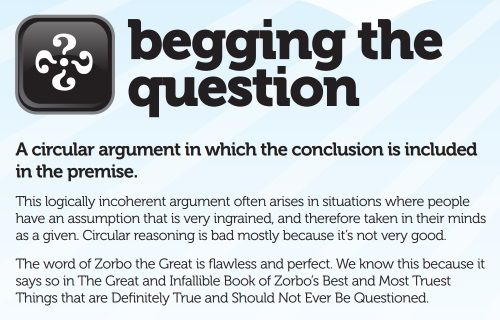
God is nothing, therefore nothing which is discovered is an aspect of God.

About 2-3 degrees Celsius per doubling of CO2. We've known that since about 1900. What's next?shickingbrits wrote:So when you give me the basic unit of climate change, warming per measure of CO2, I'll reply to your further posts.
First of all, and this is very important, the religious arguments against a literal word for word interpretation for Genesis is not something you are going to see around here. I would be more than happy to make it, again and again. The best quote I know comes from a cardinal at the time of Galileo, "The Bible tells us how to go to heaven, not how the heavens go." The Book of Genesis is not an oral dictation from God. From a historical perspective there are very few new stories in Genesis, most of them are adapted and modified from stories told by the various nations in the general region.degaston wrote:I'm not saying that evolution disproves God, but it does disprove the Bible as an inerrant source of literal truth. (Actually, the Bible disproves itself through its own numerous self-contradictions.) I suppose that it could still be the literal word of God, but in that case, God was lying, and why anyone would want to follow a God who lies is beyond me. But I think the more reasonable conclusion is that it is just a collection of stories made up and passed down by ordinary, fallible humans who may have had good intentions about creating a well-ordered society, but did not know a thing about science.
So in order to see the "value added" in the stories you have to know how they are different in terms of the stories they were copied from. These differences are sometimes subtle and sometimes drastic.The earliest written flood myth is found in the Mesopotamian Epic of Atrahasis and Epic of Gilgamesh texts. Many scholars believe that Noah and the Biblical Flood story are derived from the Mesopotamian version, predominantly because Biblical mythology that is today found in Judaism, Christianity, Islam and Mandeanism shares overlapping consistency with far older written ancient Mesopotamian story of The Great Flood, and that the early Hebrews were known to have lived in Mesopotamia. The Encyclopedia Judaica adds that there is a strong suggestion thatan intermediate agent was active. The people most likely to have fulfilled this role are the Hurrians, whose territory included the city of Haran, where the Patriarch Abraham had his roots. The Hurrians inherited the Flood story from Babylonia.
"Doubling?" Oh I do like this one. Those words left unspoken (or unwritten). You mean the doubling of the man made emissions of CO2, right?Metsfanmax wrote:About 2-3 degrees Celsius per doubling of CO2. We've known that since about 1900. What's next?
So unless you take the lowest point in all of known history, it's not a doubling and certainly not a doubling since the recent centuries.Ice cores show that carbon dioxide levels in the atmosphere have remained between 180 and 300 parts per million for the past half-a-million years. In recent centuries, however, CO2 levels have risen sharply, to at least 380 ppm.
Human CO2 emissions upset the natural balance of the carbon cycle. Man-made CO2 in the atmosphere has increased by a third since the pre-industrial era ...
No, I mean doubling of the total concentration of carbon dioxide. The atmosphere basically doesn't care whether the CO2 is anthropogenic or not: it has the same greenhouse effect. So the relevant metric is the total concentration.tzor wrote:"Doubling?" Oh I do like this one. Those words left unspoken (or unwritten). You mean the doubling of the man made emissions of CO2, right?Metsfanmax wrote:About 2-3 degrees Celsius per doubling of CO2. We've known that since about 1900. What's next?
We are absolutely in a position to double the CO2 content of the atmosphere. The pre-industrial concentration was about 280 ppm. The current concentration is about 400 ppm, a 40% increase. A typical 'worst-case' scenario -- where significant action on climate change is not taken by the global community -- involves the concentration reaching something like 1000 ppm by the end of the century, which is more than tripling the concentration.Because we have never doubled the CO2 content in the atmosphere. And we are currently in no position to do so.
So unless you take the lowest point in all of known history, it's not a doubling and certainly not a doubling since the recent centuries.Ice cores show that carbon dioxide levels in the atmosphere have remained between 180 and 300 parts per million for the past half-a-million years. In recent centuries, however, CO2 levels have risen sharply, to at least 380 ppm.
Metsfanmax wrote:About 2-3 degrees Celsius per doubling of CO2. We've known that since about 1900. What's next?
OK you started saying "per doubling." Now if you cherry pick the numbers (you take 280 but it's been as high as 300 in the pre-industrial age) and you look at the current 400 you see a rate of 1.429. If you take a "worst case scenario" ... oh yea those oversimplified computer models that can't predict shit ...Metsfanmax wrote:We are absolutely in a position to double the CO2 content of the atmosphere. The pre-industrial concentration was about 280 ppm. The current concentration is about 400 ppm, a 40% increase. A typical 'worst-case' scenario -- where significant action on climate change is not taken by the global community -- involves the concentration reaching something like 1000 ppm by the end of the century, which is more than tripling the concentration.
You're misunderstanding the point. I was not saying anything about the actual increase of carbon dioxide that we have observed. shickingbrits asked for the following information, essentially: if we were to double the concentration of CO2, how much would the temperature rise as a result? I was giving him the answer to that question, without saying that the concentration has risen by that much.tzor wrote:Metsfanmax wrote:About 2-3 degrees Celsius per doubling of CO2. We've known that since about 1900. What's next?OK you started saying "per doubling." Now if you cherry pick the numbers (you take 280 but it's been as high as 300 in the pre-industrial age) and you look at the current 400 you see a rate of 1.429. If you take a "worst case scenario" ... oh yea those oversimplified computer models that can't predict shit ...Metsfanmax wrote:We are absolutely in a position to double the CO2 content of the atmosphere. The pre-industrial concentration was about 280 ppm. The current concentration is about 400 ppm, a 40% increase. A typical 'worst-case' scenario -- where significant action on climate change is not taken by the global community -- involves the concentration reaching something like 1000 ppm by the end of the century, which is more than tripling the concentration.

shickingbrits wrote:degaston wrote:
Degaston,