As a regular visitor of this thread for the comics, I'd be delighted to not have another America-debate in this topic. I hope ya'll agree. Thanks in advance.
JBlombier wrote:As a regular visitor of this thread for the comics, I'd be delighted to not have another America-debate in this topic. I hope ya'll agree. Thanks in advance.
BigBallinStalin wrote:Liked the first two, disagreed with the last. Not even a chuckle on that last one.
Yeah, but I have to diversify my target audience. Gotta post something for the commies to enjoy.
Well, people that know me in real life might say I am closer to the "commies" than most on this site, but I agree with BBS. You don't obtain a random sequence of bits and build a machine that use it as an operating system. You design a general purpose computing machine, then craft a sequence of bits to be the operating system. I'll grant, however, that sometimes it seems like Microsoft has almost gone the former route, assembling a sequence of bits and gradually converting it into an operating system.
BigBallinStalin wrote:Liked the first two, disagreed with the last. Not even a chuckle on that last one.
Yeah, but I have to diversify my target audience. Gotta post something for the commies to enjoy.
Well, people that know me in real life might say I am closer to the "commies" than most on this site, but I agree with BBS. You don't obtain a random sequence of bits and build a machine that use it as an operating system. You design a general purpose computing machine, then craft a sequence of bits to be the operating system. I'll grant, however, that sometimes it seems like Microsoft has almost gone the former route, assembling a sequence of bits and gradually converting it into an operating system.
RIght. But if you made a machine that can somehow transform bits into pixels and coordinates for those pixels on a 2D screen, then the sequences of bits needed to generate any movie already exists somewhere in the digits of pi.
The comic seems to me to be saying it's ridiculous to claim ownership of those digits of the binary representation of pi, even if it is you who identified them. Kind of like it would be ridiculous to claim ownership on the abstract concept of a circle.
Of course one can argue there's a difference between ownership of the abstract series of digits and ownership of the representation of those digits on a certain machine, but the general concept does not seem completely without merit to me. Of course I realize the realities faced by filmmakers and so on, but the notion of owning information seems somewhat dangerous as well. Even current copyright laws seem to only lease the information to the discoverer, not outright give ownership of it to him.
Also:
Click image to enlarge.
Highest score: 3063; Highest position: 67;
Winner of {World War II tournament, -team 2010 Skilled Diversity, [FuN||Chewy]-[XII] USA};
8-3-7
Just because I might be able to find a sequence of bits in pi which could be mapped to an image of a legal document saying that the entire Disney empire belongs to me with all necessary signatures, that would not make it true.
In general, I feel intellectual property should have a time limit. The fact that Mickey Mouse is not yet in the public domain strikes me as wrong. Patents and copyrights are meant to preserve the value of the efforts of the creators, but not forever. Society cannot advance if all such developments are protected forever.
ender516 wrote:Just because I might be able to find a sequence of bits in pi which could be mapped to an image of a legal document saying that the entire Disney empire belongs to me with all necessary signatures, that would not make it true.
In general, I feel intellectual property should have a time limit. The fact that Mickey Mouse is not yet in the public domain strikes me as wrong. Patents and copyrights are meant to preserve the value of the efforts of the creators, but not forever. Society cannot advance if all such developments are protected forever.
I still can't believe the 'Happy Birthday' will still be under American copyright until 2030.
ender516 wrote:Just because I might be able to find a sequence of bits in pi which could be mapped to an image of a legal document saying that the entire Disney empire belongs to me with all necessary signatures, that would not make it true.
In general, I feel intellectual property should have a time limit. The fact that Mickey Mouse is not yet in the public domain strikes me as wrong. Patents and copyrights are meant to preserve the value of the efforts of the creators, but not forever. Society cannot advance if all such developments are protected forever.
Yeah, that's what I'm saying as well. The representation of the document wouldn't give you the Disney Empire cause the information contained in that sequence would only create the document. The fact that we assign certain meaning to that document is a different step in the process. However in the case of music and film the representation IS the product. Digitize the music into 1s and 0s and that information fully represents the end product. I think giving ownership over such abstract information is a sticky issue and, as you say, should at the very least have a time limit.
I'd like to take the view that the information should be free and people should pay for the extras, like going to the cinema rather than seeing the movie at home, or going to a concert rather than listening to it on your computer. But doesn't the advance of technology create a problem with that since we are continuously giving people stuff that provides closer approximations of the cinema/concert experience? This view of the problem assumes there will always be a large gap between what people can experience in their living room and what they can experience in these communal settings. I'm not sure if that gap will always be there. So basically this is one issue where I really have no clue what the solution is.
Anyway:
Click image to enlarge.
Click image to enlarge.
Click image to enlarge.
Highest score: 3063; Highest position: 67;
Winner of {World War II tournament, -team 2010 Skilled Diversity, [FuN||Chewy]-[XII] USA};
8-3-7
On that last one (which could use a bigimg tag, btw), I'm glad to see no neurobiology texts. The idea of trying to understand the brain that is trying to understand the universe that contains it always leaves me sad and perplexed.
ender516 wrote:On that last one (which could use a bigimg tag, btw), I'm glad to see no neurobiology texts. The idea of trying to understand the brain that is trying to understand the universe that contains it always leaves me sad and perplexed.
the last one is actually 7 distinct images.
also
Click image to enlarge.
Highest score: 3063; Highest position: 67;
Winner of {World War II tournament, -team 2010 Skilled Diversity, [FuN||Chewy]-[XII] USA};
8-3-7
ender516 wrote:On that last one (which could use a bigimg tag, btw), I'm glad to see no neurobiology texts. The idea of trying to understand the brain that is trying to understand the universe that contains it always leaves me sad and perplexed.
the last one is actually 7 distinct images.
also
Click image to enlarge.
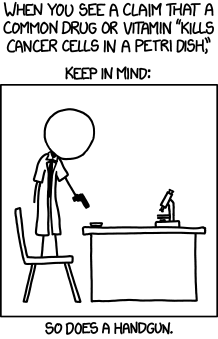
I think we're onto something here. So, logically speaking, we should probably start Bullet Therapy™ as a form of cancer (or really, any illness) treatment.
I think I'd buy a poster based on that last one (though more detail would be nice)
I started thinking about the growth of an island and how its perimeter would vary with its area, and Wheeler is right, UNLESS THE WORLD IS A SPHERE. In that case eventually the island covers the entire surface. So, is our knowledge space positively curved? And how did one of the foremost researchers in general relativity miss that point? The Flat Earth Society must be notified.