

Eastern Hemisphere [Quenched]
Moderator: Cartographers
Forum rules
Please read the Community Guidelines before posting.
Please read the Community Guidelines before posting.
-
whitestazn88
- Posts: 3128
- Joined: Mon Feb 05, 2007 2:59 pm
- Gender: Male
- Location: behind you
- Contact:
Re: Eastern Hemisphere: no Trading Co's! pg. 19 [I]
i really liked the trading co's... but either way you go, this looks great, and will play fine

Re: Eastern Hemisphere: no Trading Co's! pg. 19 [I]
Maybe you can re-use the ships to make sea routes like between South Africa and Australia.
It will open the map a bit and bring back a very cool graphic feature.
It will open the map a bit and bring back a very cool graphic feature.
De gueules à la tour d'argent ouverte, crénelée de trois pièces, sommée d'un donjon ajouré, crénelé de deux pièces
Gules an open tower silver, crenellated three parts, topped by a apertured turret, crenellated two parts
Gules an open tower silver, crenellated three parts, topped by a apertured turret, crenellated two parts

Re: Eastern Hemisphere: no Trading Co's! pg. 19 [I]
I miss the trading companies...
However - the new "empire" idea is a brilliant idea.
C.
PS - would not add Portugal - most of their empire was American (I believe?) (And I think 4 empires is enough)
However - the new "empire" idea is a brilliant idea.
C.
PS - would not add Portugal - most of their empire was American (I believe?) (And I think 4 empires is enough)

Highest score : 2297
Re: Eastern Hemisphere: no Trading Co's! pg. 19 [I]
Trading companies made your map unique... Now its like so many others...

Re: Eastern Hemisphere: no Trading Co's! pg. 19 [I]
Portugal had only Brazil as a colony in the Americas. In Africa they had Mozambique, Angola, Guinea Bassao, Sao Tome and Principe and Cape Verde (mind the lack of appropriate accents). In Asia they had one or two as well.yeti_c wrote:PS - would not add Portugal - most of their empire was American (I believe?) (And I think 4 empires is enough)
Spain however, only had 1 colony in Africa ever...to the best of my knowledge.
I would include Portugual if at all possible. yeti might be right about the amount of empires though, I don't suppose it would be beneficial to unbalance it entirely by overflooding the bonus possibilities.
Re: Eastern Hemisphere: no Trading Co's! pg. 19 [I]
Wow - I never knew Portugal had such an extensive Empire!foregone wrote:Portugal had only Brazil as a colony in the Americas. In Africa they had Mozambique, Angola, Guinea Bassao, Sao Tome and Principe and Cape Verde (mind the lack of appropriate accents). In Asia they had one or two as well.yeti_c wrote:PS - would not add Portugal - most of their empire was American (I believe?) (And I think 4 empires is enough)
Spain however, only had 1 colony in Africa ever...to the best of my knowledge.
I would include Portugual if at all possible. yeti might be right about the amount of empires though, I don't suppose it would be beneficial to unbalance it entirely by overflooding the bonus possibilities.
C.
Highest score : 2297
Re: Eastern Hemisphere: no Trading Co's! pg. 19 [I]
They were pretty good at this colonialisation thing in their timeyeti_c wrote:Wow - I never knew Portugal had such an extensive Empire!foregone wrote:Portugal had only Brazil as a colony in the Americas. In Africa they had Mozambique, Angola, Guinea Bassao, Sao Tome and Principe and Cape Verde (mind the lack of appropriate accents). In Asia they had one or two as well.yeti_c wrote:PS - would not add Portugal - most of their empire was American (I believe?) (And I think 4 empires is enough)
Spain however, only had 1 colony in Africa ever...to the best of my knowledge.
I would include Portugual if at all possible. yeti might be right about the amount of empires though, I don't suppose it would be beneficial to unbalance it entirely by overflooding the bonus possibilities.
C.

On topic: This may be a tad bit pedantic...but South Africa was no longer a colony in 1910. That year it officially became a Union. Its a bit of a technicality since it still had British influence because of the governance structures.
Re: Eastern Hemisphere: no Trading Co's! pg. 19 [I]
Just assume it's before May 31st or something!?!?foregone wrote:On topic: This may be a tad bit pedantic...but South Africa was no longer a colony in 1910. That year it officially became a Union. Its a bit of a technicality since it still had British influence because of the governance structures.
C.
Independence: The Union of South Africa was created on May 31, 1910; became sovereign state within British Empire in 1934; became a republic on May 31, 1961; left the Commonwealth in October 1968; rejoined the Commonwealth in June 1994.
Highest score : 2297
Re: Eastern Hemisphere: no Trading Co's! pg. 19 [I]
As I said, probably a little pedantic. Nothing to see here, move right along.yeti_c wrote:Just assume it's before May 31st or something!?!?foregone wrote:On topic: This may be a tad bit pedantic...but South Africa was no longer a colony in 1910. That year it officially became a Union. Its a bit of a technicality since it still had British influence because of the governance structures.
C.
Independence: The Union of South Africa was created on May 31, 1910; became sovereign state within British Empire in 1934; became a republic on May 31, 1961; left the Commonwealth in October 1968; rejoined the Commonwealth in June 1994.


Re: Eastern Hemisphere: no Trading Co's! pg. 19 [I]
why not even out the 'empires' one HQ in asia, one in australia, one in africa and one in europe. then you couls still use the trading companies but it would be so centralized in europe. might not fit your time scale though.
Re: Eastern Hemisphere: no Trading Co's! pg. 19 [I]
Cos - no-one had empires from those areas at this time...mibi wrote:why not even out the 'empires' one HQ in asia, one in australia, one in africa and one in europe. then you couls still use the trading companies but it would be so centralized in europe. might not fit your time scale though.
C.
Highest score : 2297

Re: Eastern Hemisphere: no Trading Co's! pg. 19 [I]
I'm sad to see the TC's go, even if I did have mild concerns about their effectiveness... the ocean looks a little empty now 

PB: 2661 | He's blue... If he were green he would die | No mod would be stupid enough to do that
-
AndyDufresne

- Posts: 24919
- Joined: Fri Mar 03, 2006 8:22 pm
- Location: A Banana Palm in Zihuatanejo
- Contact:
Re: Eastern Hemisphere: no Trading Co's! pg. 19 [I]
I'm sadden to see the Trading Companies go, but uniting the empire could be a replacement.
And as mentioned, the seas look plain and barren now...and empty.
And as mentioned, the seas look plain and barren now...and empty.
--AndyThe ocean is a desert with its life underground
And a perfect disguise above
Re: Eastern Hemisphere: no Trading Co's! pg. 19 [I]
pamoa wrote:Maybe you can re-use the ships to make sea routes like between South Africa and Australia.
It will open the map a bit and bring back a very cool graphic feature.
De gueules à la tour d'argent ouverte, crénelée de trois pièces, sommée d'un donjon ajouré, crénelé de deux pièces
Gules an open tower silver, crenellated three parts, topped by a apertured turret, crenellated two parts
Gules an open tower silver, crenellated three parts, topped by a apertured turret, crenellated two parts
Re: Eastern Hemisphere: no Trading Co's! pg. 19 [I]
Oak,
here is another option if you wanted to keep the trading companies. Instead of having the trading companies bombard foreign territories, do this:
Each trading company has a TO and FROM circle, one for attacking one way to the European power and one attacking one way from the European power. This way, if players are shut out of europe, all they have to do is attack the trading company from a colonial territory and then attack the European power from the trading company. The purpose of having a TO and FROM territory is so that a colony cannot attacka trading company and then attack a far away colony from the trading company, warping all over the map. With a TO and FROM, they have to get to the European power first, and then back to the trading company and then off to a foreign colony.
With this in place, it makes Europe less isolated as well as harder to hold as the colonies can 'revolt' back to their European power if its not strong enough. I would also suggest putting some colonies in asia as well for balance, history be damned, though I am sure you can find some east meets west connection there if you look hard enough.
here is another option if you wanted to keep the trading companies. Instead of having the trading companies bombard foreign territories, do this:
Each trading company has a TO and FROM circle, one for attacking one way to the European power and one attacking one way from the European power. This way, if players are shut out of europe, all they have to do is attack the trading company from a colonial territory and then attack the European power from the trading company. The purpose of having a TO and FROM territory is so that a colony cannot attacka trading company and then attack a far away colony from the trading company, warping all over the map. With a TO and FROM, they have to get to the European power first, and then back to the trading company and then off to a foreign colony.
With this in place, it makes Europe less isolated as well as harder to hold as the colonies can 'revolt' back to their European power if its not strong enough. I would also suggest putting some colonies in asia as well for balance, history be damned, though I am sure you can find some east meets west connection there if you look hard enough.

Re: Eastern Hemisphere: no Trading Co's! pg. 19 [I]
Wait, am I hearing that you miss the Trading Co's mibi? You were one of the more vocal opponents!mibi wrote:Each trading company has a TO and FROM circle, one for attacking one way to the European power and one attacking one way from the European power. This way, if players are shut out of europe, all they have to do is attack the trading company from a colonial territory and then attack the European power from the trading company. The purpose of having a TO and FROM territory is so that a colony cannot attacka trading company and then attack a far away colony from the trading company, warping all over the map. With a TO and FROM, they have to get to the European power first, and then back to the trading company and then off to a foreign colony.
If the Trading Co's are going to be in there, I think that there role should try to be historical accurate. Allowing the European states to be conquered from a Trading Co that was captured from another part of the globe might very well be better for gameplay, but it seems a bit gimmicky to me - I don't know of a case where an African or Asian power took control of the East India Trading Company and then used that as a springboard to take the british crown.
Anyway, I'm hearing voices saying keep the TCs, and others saying that while they were an interesting idea the map is better without. I'm not married to either version of the map, so maybe I should run a poll and see what folks think.
Re: Eastern Hemisphere: no Trading Co's! pg. 19 [I]
I could careless about the trading companies as long as the game play is balanced.oaktown wrote:Wait, am I hearing that you miss the Trading Co's mibi? You were one of the more vocal opponents!mibi wrote:Each trading company has a TO and FROM circle, one for attacking one way to the European power and one attacking one way from the European power. This way, if players are shut out of europe, all they have to do is attack the trading company from a colonial territory and then attack the European power from the trading company. The purpose of having a TO and FROM territory is so that a colony cannot attacka trading company and then attack a far away colony from the trading company, warping all over the map. With a TO and FROM, they have to get to the European power first, and then back to the trading company and then off to a foreign colony.
If the Trading Co's are going to be in there, I think that there role should try to be historical accurate. Allowing the European states to be conquered from a Trading Co that was captured from another part of the globe might very well be better for gameplay, but it seems a bit gimmicky to me - I don't know of a case where an African or Asian power took control of the East India Trading Company and then used that as a springboard to take the british crown.
Anyway, I'm hearing voices saying keep the TCs, and others saying that while they were an interesting idea the map is better without. I'm not married to either version of the map, so maybe I should run a poll and see what folks think.
The subtitle of this map is "the end of empires". Well how do these empires end? The colonies assert their power and usurp Empirical control. I don't seen how it's not very historically accurate and further more, is this a game or a history lesson? We mapmakers can only infuse so many guidlines for how the map plays out. We do our best to push the gameplay in the direction we want it to go, but whats the game starts, and the armies are randomly all over the map, historical accuracy is the last thing on peoples minds.
It's up to you, the trading companies could work if you make a small sacrifice to the gameplay gods.
Re: Eastern Hemisphere: Trading Co. poll pg 1. [I]
of those two choices, I had to vote A.
Re: Eastern Hemisphere: Trading Co. poll pg 1. [I]
- Click image to enlarge.
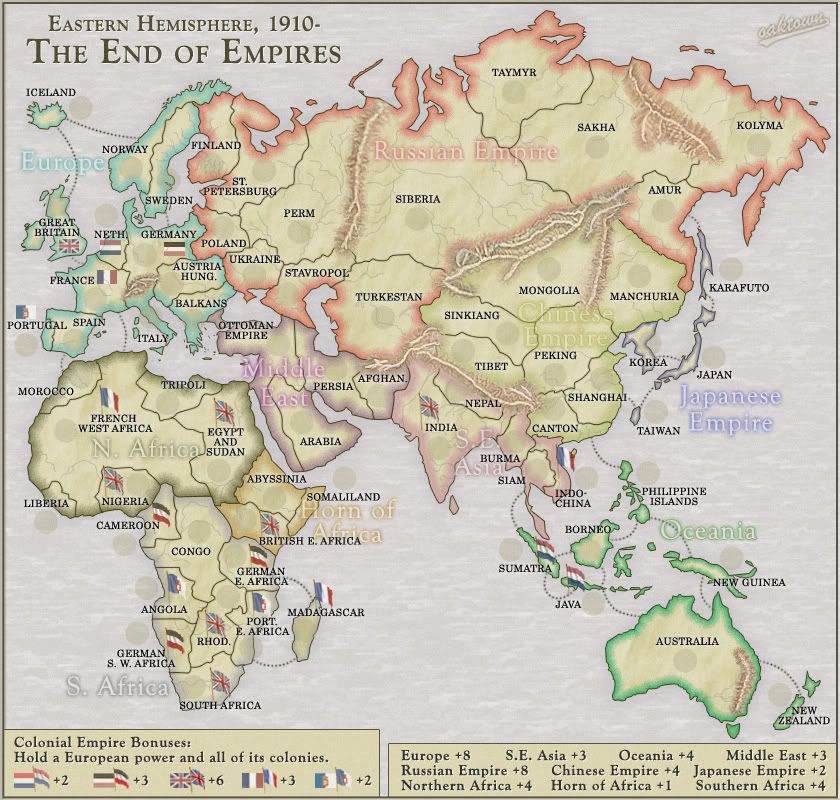
It should be noted that Portugal adopted their current flag in 1911 - this is the old one.
And who thinks we need a sea route from Africa east?? Maybe I'll connect India with British East Africa via a neutral-starting British Trading Company...
Re: Eastern Hemisphere: Trading Co. poll pg 1. [I]
Uh, you took out the good part and left the imbalance.
Re: Eastern Hemisphere: Trading Co. poll pg 1. [I]
- Click image to enlarge.
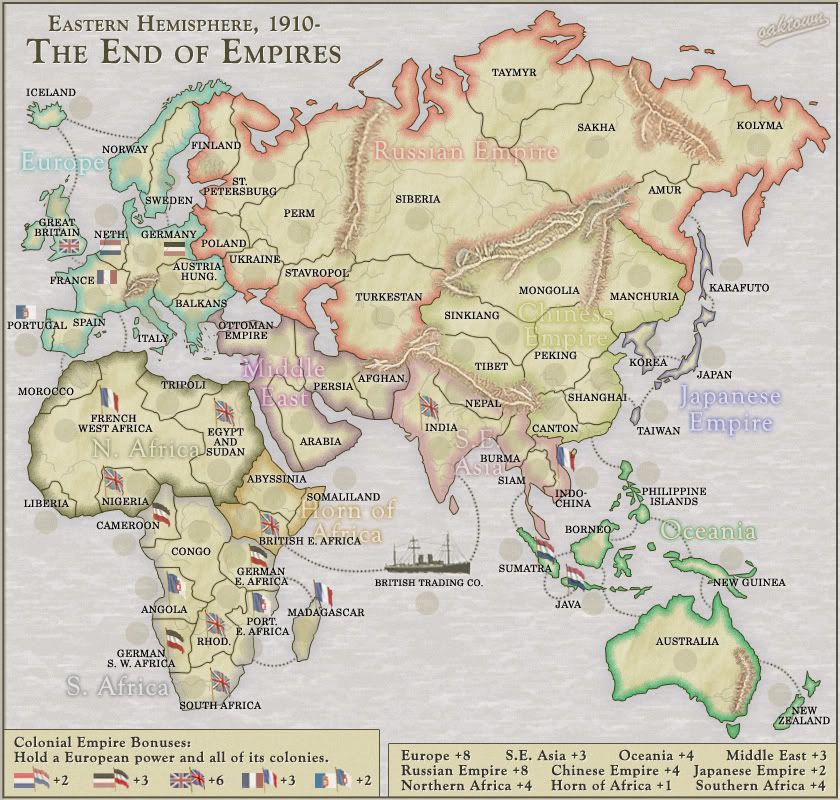
Could you possibly be more specific? What I'm seeing (and maybe this is your concern) is that the South Africa/Europe combination is now an unstoppable force, so the bonuses need some adjustment... or maybe we scrap an empire.mibi wrote:Uh, you took out the good part and left the imbalance.

Re: Eastern Hemisphere: Trading Co. poll pg 1. [I]
Mememe! I hate it!oaktown wrote:I'm sure somebody will hate this, but I think it solves the problem of Africa now being too easy to hold... now a region other than North Africa can be hit by a foreign power.
Well, maybe hate is too strong a word. It just seems like something slapped on to fix a problem...

Can Britain attack the British Trading Co. in that version? If so, then I think that should be said somewhere. If not, why not just put a route between B. E. Africa and India directly, without a ship there?
Re: Eastern Hemisphere: Trading Co. poll pg 1. [I]
it was an idea that addressed two concerns: 1) africa is really easy to hold without the trading company bombardments, and 2) the seas look really empty now. A direct link from Africa to Asia doesn't make sense, unless it's just to the middle east somewhere.
I'm just fussing around with various ideas to improve the play. If some don't work, they won't stick.
I'm just fussing around with various ideas to improve the play. If some don't work, they won't stick.
Re: Eastern Hemisphere: Trading Co. poll pg 1. [I]
I'm happy that the Portuguese entered the game. The South Africa thing might be fixed by adding sea routes to it from the British Trading Co and/or round to the west side of Europe. Even today the Cape of Good Hope is still a major route around Africa, though it lost quite some appeal as a result of the Suez.