
- Click image to enlarge.
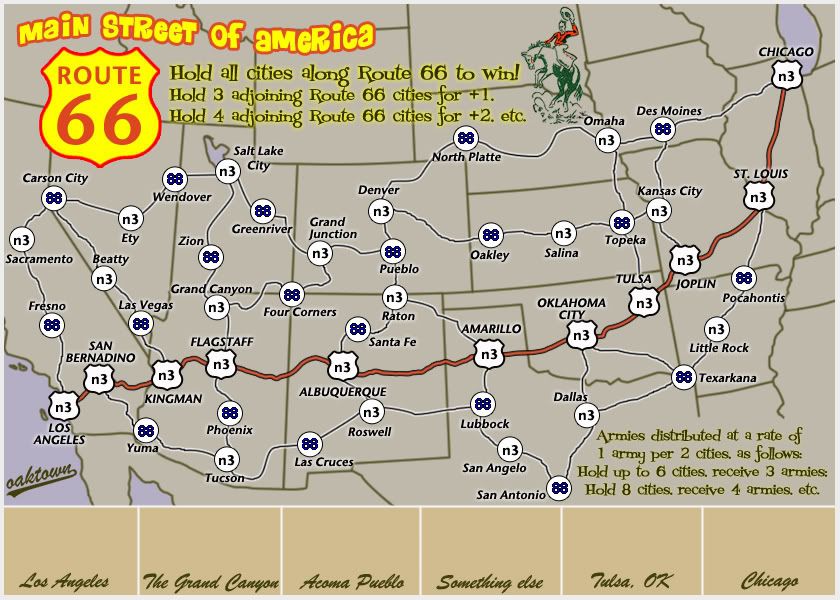
Mostly I just set the file up better to make future changes, but since it had been a while I thought I ought to post something.


Moderator: Cartographers



Agreed. I'll be away for the next two weeks, so when I get back I'll decide which of my current projects I care about enough to carry on.MrBenn wrote:It would appear that development of this map has stalled.
Oaktown, after you've got an update, feel free to put yourself back in the drafting room.
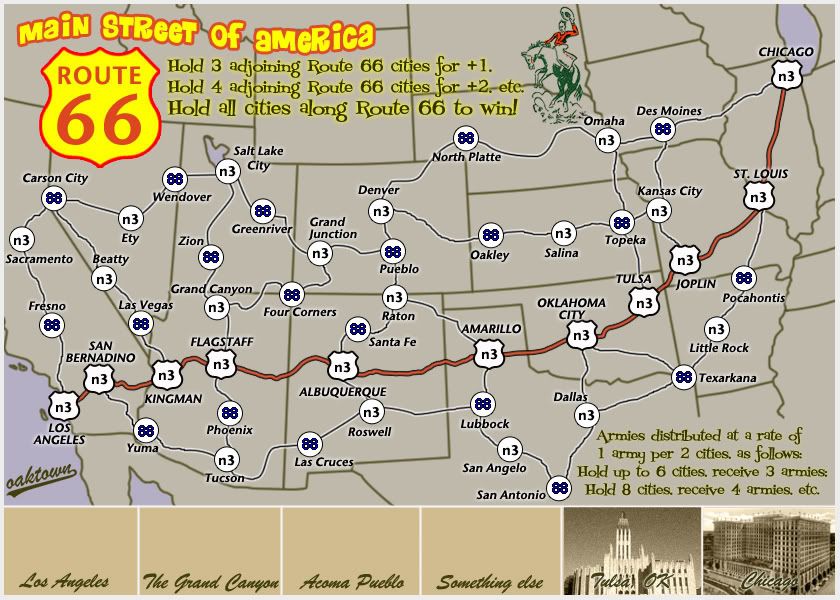



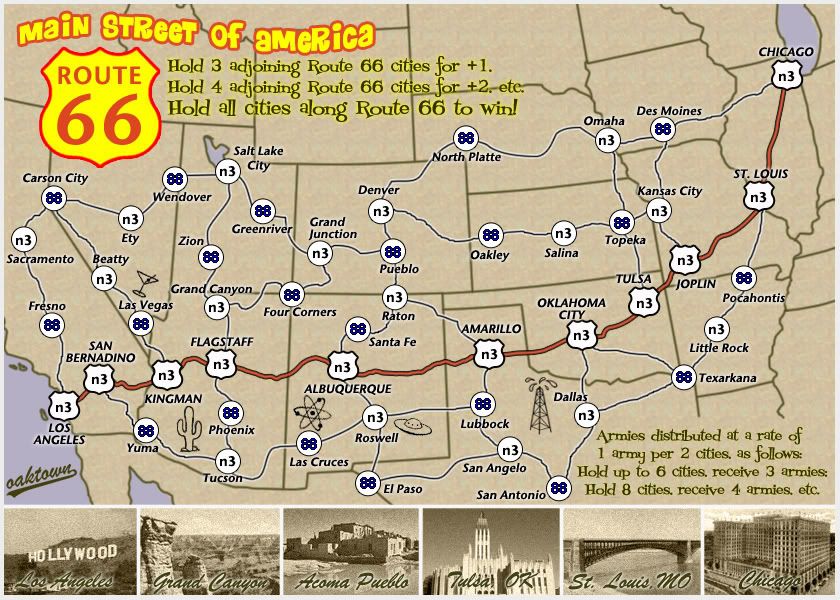
Yepsailorseal wrote:I don't understand why the cities don't have 88s on them but maybe that's just me.
… n3 = they start with 3 neutral armies.sailorseal wrote:My big boy banana was out the whole time
AndyDufresne wrote:Forever linked at the hip's-banana! (That sounds strange, don't quote me.)AndyDufresne wrote:Many Happy Bananas to everyone, lets party...with Bananas.
--Andy
I disagree. No one will bother to attack 5 neutrals except to cross from the north half to the south half and vice-versa. The bonus and objective will never come into play if the neutrals are that high.LED ZEPPELINER wrote:maybe you could make it like a neutral 5 on the stops on route 66, just to make it a touch harder
I have to side with ZeakCytho on this one no one is gonna waste good troops on a five nuetralZeakCytho wrote:I disagree. No one will bother to attack 5 neutrals except to cross from the north half to the south half and vice-versa. The bonus and objective will never come into play if the neutrals are that high.LED ZEPPELINER wrote:maybe you could make it like a neutral 5 on the stops on route 66, just to make it a touch harder


 )
) 
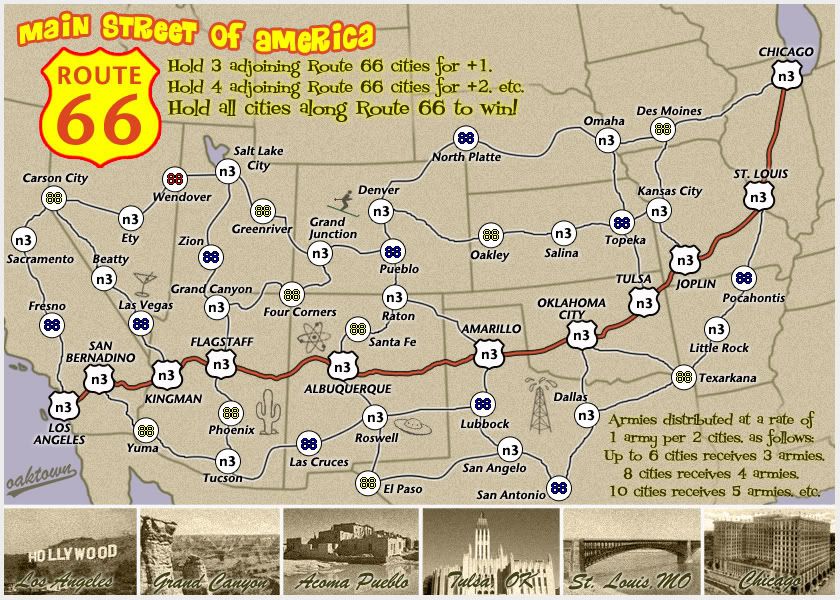

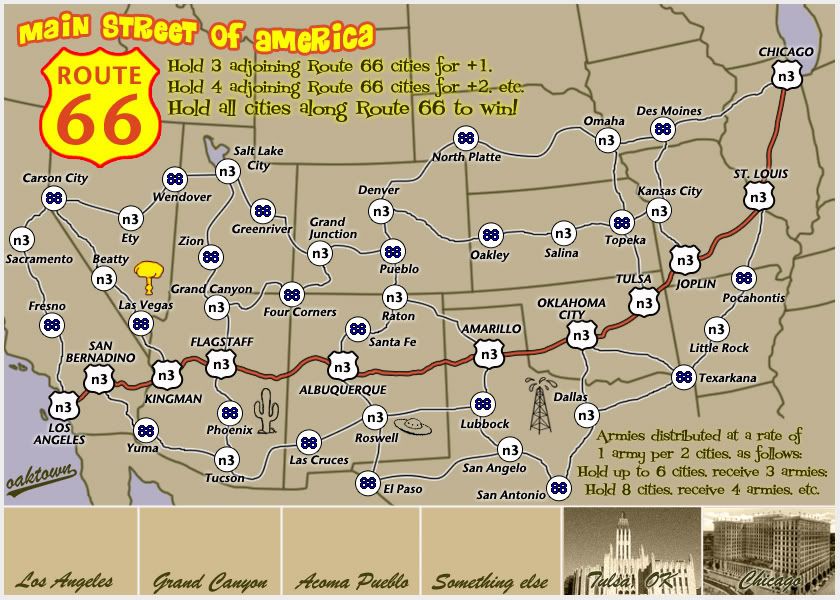
 ) It could be worth adjusting the deployment to +3 for up to 7; +4 for 9, +5 for 11 etc...
Correct. Two starting positions only, so they'd be ignored in games of 3 or more players.MrBenn wrote:Just so I get this straight in my head - you're planning on fixing the positions for 1v1 games using starting positions, as laid out above?
For more than 1v1 games, those same positions would be dealt out randomly? Is that right?
Right again MrBenn. The five army drop is based on the accelerated rate of one army/two cities.MrBenn wrote:You mention that with 10 terrs on the drop, you'll get 5 armies... I'm assuming that players won't also get the standard +3? (so they will only get 5, rather than 5+3).
All games other than two player games would start with the normal three army drop... for example:MrBenn wrote:How would the numbers pan out for other numbers of players (I'm too tired to work it out myself
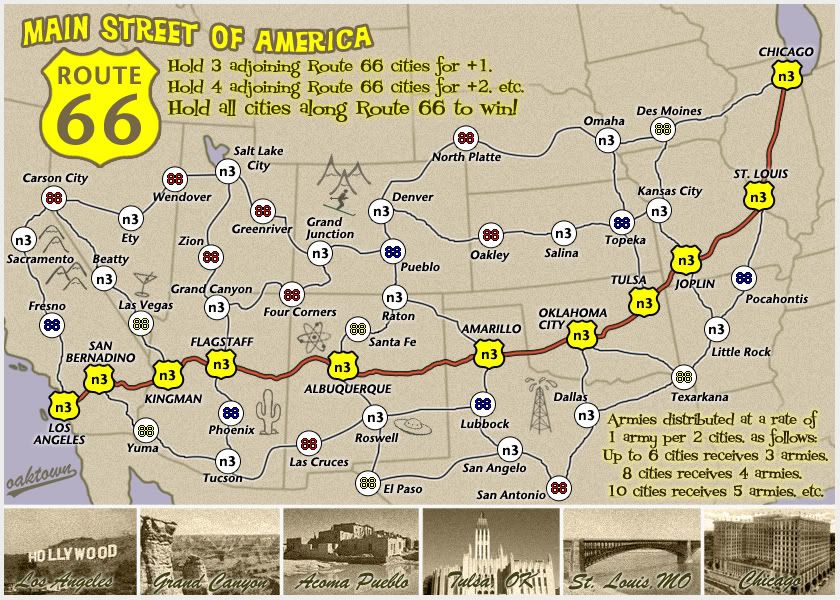
Actually, that's not quite how starting positions work... each player will randomly be assigned a group, with the remaining one split up... so Player 1 could be red, Player 2, Blue, and yellow split up. The other thing to remember is that in a 3p game, each player will get one group in any case.oaktown wrote:Yellow, blue, and red 88s are starting positions. In a two player game one player will start with all of the blues, the other with all of the yellows. The nine reds will be randomly assigned between blue, yellow, and neutral.
Sorry, I mis-spoke. I should have said that yellows, blues, and reds are starting territories, not positions. Yellow and blue and starting positions. The reds are unassigned territores which will be split among the player 1, player 2, and neutral.MrBenn wrote:Actually, that's not quite how starting positions work... each player will randomly be assigned a group, with the remaining one split up... so Player 1 could be red, Player 2, Blue, and yellow split up. The other thing to remember is that in a 3p game, each player will get one group in any case.oaktown wrote:Yellow, blue, and red 88s are starting positions. In a two player game one player will start with all of the blues, the other with all of the yellows. The nine reds will be randomly assigned between blue, yellow, and neutral.