@BVP:
Regarding this: "
it just shows GDP per capita and healthcare spending ratios. Recall that government expenditures are included in GDP, so if a government spends a lot relative to the size of its economy, then the higher GDP will "reduce" the actual health care costs. It's not a good ratio." and...
"
Increase G, and divide health expenditures by GDP, and you get a lower "cost." "
GDP = C + I + G + NX
C = private consumption
I = investment
G = government spending
NX = net exports (exports minus imports)
Further expansion on the above:
So, if the government "takes over" the healthcare industry and private consumption shrinks, yet government expenditure increases, is there any change in GDP since the decrease in private consumption (-100) will be offset by the increase in government outlays (+100)? It depends on how much the government takes from C and adds to G (and thus into healthcare costs). It could be the case that the decrease in C (-100) isn't offset by an increase in G (+100). Suppose G amounts to +50. Where's the other +50? It could be due to deadweight costs, i.e. losses due to price controls. Or it could be that government spending isn't as efficient as private consumption. My main point is that the GDP figure doesn't tell us what's going on.
Note: this scenario would result in a decrease of total GDP, thus enlarging the healthcare costs to GDP ratio, which would contradict my claim. (perhaps, I should've spent an additional hour organizing and explaining my main points, but oh well, my statement "It's not a good ratio" still stands).
Other scenario:
Suppose the economy is doing great. C and I are increasing, thus boosting GDP. Healthcare costs to GDP could become reduced. (so the italized could hold true, but...)
Or what if the government includes fiscal stimulus in its G? It builds a bunch of roads to nowhere, or scraps off 2 inches of the highway and dumps down new asphalt. This is an increase in GDP. Would C fall? It depends on how the government procured the cash, e.g. deficit spending, borrowing money, or additional taxation. If no taxation, then C and I could remain the same, or maybe increase. An increase in GDP would reduce the healthcare costs relative to GDP.
My main point is that the ratio isn't good because it doesn't really explain what's going on. The above two scenarios and more could be occurring simultaneously, or there could be time lags, so the data has yet to catch up, or be updated. (oh god, now I have to get into PPP, and how it varies across countries.... I won't for now.).
:
It also depends on how each government calculates its spending. If the government controls your economic choices, it can force you to spend less than you're willing to pay for healthcare. Or, since it subsidizes it, perhaps more people would spend more; however, spend more on what? If an increased demand for healthcare is not being met by an increase in supply of healthcare, then there would be a shortage of healthcare services--it depends on how much control the national/local government exerts on the production of healthcare. Usually, increased state control via state ownership or certain regulations over an industry decreases its responsiveness to changes in demand (in short, it depends on more than that, but I don't want to type more).
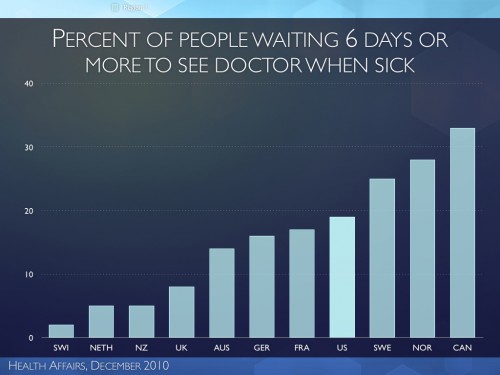
A shortage would result in longer waiting times for receiving medical attention or to get a certain operation. That cost isn't included, and in order for the healthcare industry to meet this additional demand, it must spend more in order to supply more. The increase in supply results in an additional "cost" in healthcare services, but it can be beneficial since it's meeting the demand of customers. Suppose the government inhibits the expansion of healthcare services. Healthcare costs are prevented from rising, but healthcare services are also prevented from meeting the demand. This means that customer satisfaction is being prevented from being met.
So, as you can see, there's much left wanting in healthcare "costs" and GDP measurements, which is why it's not a good ratio. These measurements lack meaning.
(I'd love to see a cross-country comparison of average wait times for surgeries or doctor visits).
GDP is useful for measuring trends and relative sizes; however, it doesn't explain what's happening beneath that figure.
Consider the formula: GDP = Consumption + Investment + Government + (net exports - net imports)
GDP aggregates various expenditures into these categories, which reflect the value of all final goods and services within a year into an average price. Hence, the price of US GDP is about $15 trillion.
If countries with a socialized healthcare program have relatively less expenditures on health care costs, it doesn't follow that socialized healthcare is the way to go. It depends on what exactly are healthcare costs and how the expenditures, or outlays, are calculated. The aggregates of private consumption, investment, government spending, and (exports - imports) vary in efficiency (thus vary in their ability to satisfy the actual desires of demanders), and within these aggregates are sectors which also vary in efficiency.
And, where exactly do the healthcare goods come from? If it's imported, does that mean that government did a great job in improving healthcare because it spends less on healthcare relative to the US? (No, it's more complicated than what the data reveals).
Furthermore, using Sym's wiki data, the quality of the healthcare goods produced is unknown. The casual relation between increased proportion of government spending on healthcare, the reduced healthcare costs relative to GDP, and the alleged outcomes of decreased amenable mortality, increased life expectancies, etc. is not explained at all.
:
(So, this is why I didn't want to expand on the italicized. I spend all this time further explaining what I'm trying (and failed to) compress into a couple of sentences. I apologize for that failure. However, my point that "it's not a good ratio" still stands.
Unfortunately, many people fall for these statistics (like Symmetry). With econometrics comes great responsibility (haha). On face-value, it appears great! But it doesn't really explain what's happening in reality. So, just because a country (government and/or people) spends less on healthcare, it doesn't follow that the services rendered are relatively better. In short, the presented evidence from Sym's wiki link sucks, and further data analysis is required but lacking from the wiki link; therefore, Symmetry's data doesn't support his stance.
My guess is that he's just fitting facts to his previously conceived conclusion (e.g. probably some normative judgment about social justice). Moral standpoints which overlook consequences are dangerous.
Frank Shostak from GDP wiki wrote:
The GDP framework cannot tell us whether final goods and services that were produced during a particular period of time are a reflection of real wealth expansion, or a reflection of capital consumption.
For instance, if a government embarks on the building of a pyramid, which adds absolutely nothing to the well-being of individuals, the GDP framework will regard this as economic growth. In reality, however, the building of the pyramid will divert real funding from wealth-generating activities, thereby stifling the production of wealth.
So what are we to make out of the periodical pronouncements that the economy, as depicted by real GDP, grew by a particular percentage? All we can say is that this percentage has nothing to do with real economic growth and that it most likely mirrors the pace of monetary pumping.
We can thus conclude that the GDP framework is an empty abstraction devoid of any link to the real world. Notwithstanding this, the GDP framework is in big demand by governments and central bank officials since it provides justification for their interference with businesses. It also provides an illusory frame of reference to assess the performance of government officials.
Based on what I've written, I hope that the underlined has become more clear.













 If I had to find a way to make it constitutional, it'd be that the system can be applied by the individual states. As for procedure, the states can consult with professional doctors associations themselves to discuss best practices.