lightspeed limit violation?

\\OFF-TOPIC// conversations about everything that has nothing to do with Conquer Club.

Moderator: Community Team

Forum rules
Please read the Community Guidelines before posting.
User avatar
Mr_Adams
Posts: 1987
Joined: Fri Jul 13, 2007 8:33 pm
Gender: Male

Re: lightspeed limit violation?

Post by Mr_Adams »

Metsfanmax wrote:As an example, we have done experiments where we "link" two particles together and have them fly off in opposite directions over macroscopic scales (kilometers, say), and change the state of one particle while simultaneously measuring the other. We find the other particle changes before it possibly could have learned about the first particle's change by a light signal.

So we could have instantaneous communications across interstellar distances? :shock:

Source? Sounds like something Orson Scott Card would write about. I believe he called it an "Ansible".
Image
User avatar
Lord and Master
Posts: 64
Joined: Tue Jul 31, 2007 3:38 pm
Gender: Male
Location: Wherever

Re: lightspeed limit violation?

Post by Lord and Master »

Metsfanmax wrote:This does not conflict with special relativity. The speed limit c is a limit on the speed of a causal connection (or, as it's commonly said, it is the speed of information exchange). It says, basically, that an event at point X could not have been influenced by an event at point Y in the past, if a light signal released at the time of event at Y would not have reached point X by the time of the event at that point.
The nonlocality of quantum mechanics avoid this problem in a subtle way - it says that a quantum state connecting two "particles" exists over the entirety of space, and changing the quantum state changes it everywhere; those two connected particles are still parts of that quantum state and are necessarily changed together, so it makes no sense to say that a change in one particle "causes" a change in the other.
The only meaningful interpretation is that a change in the state occurs, which influences all the particles tied to that state. It's tricky, but experiments tell us that this must be the case. As an example, we have done experiments where we "link" two particles together and have them fly off in opposite directions over macroscopic scales (kilometers, say), and change the state of one particle while simultaneously measuring the other. We find the other particle changes before it possibly could have learned about the first particle's change by a light signal.
That's more than "simple" sleight-of-hand isn't it?! To say that something occurring instantaneously over vast distances is not violating relativity as it's merely a "change of state" is fundamentally bollocks! At the very least it's invoking occurrences in some "hyper-space"...
Anyway the Bell theorem had 2 assumptions and Niels Bohr, years before this inequality, had always advocated the other possiblity; ie that at a quantum sub-atomic level, nothing really exists until we come along to measure it. While this sounds preposterous he (Bohr) had a track record for having an uncanny knack of knowing what the correct answer would be before even bothering with experiments.
Wouldn't the preservation of locality be preferable to the legerdemaine demonstrated above?
Image
User avatar
Haggis_McMutton
Posts: 403
Joined: Sun Mar 26, 2006 11:32 am
Gender: Male

Re: lightspeed limit violation?

Post by Haggis_McMutton »

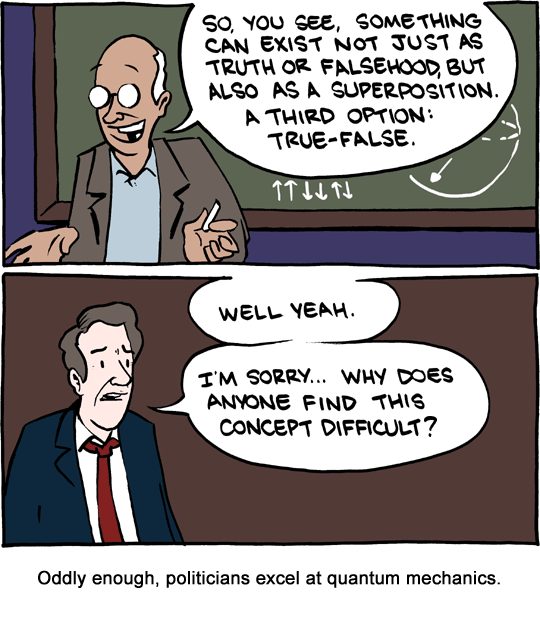
Comic related:

Image
Highest score: 3063; Highest position: 67;
Winner of {World War II tournament, -team 2010 Skilled Diversity, [FuN||Chewy]-[XII] USA};
8-3-7
User avatar
Mr_Adams
Posts: 1987
Joined: Fri Jul 13, 2007 8:33 pm
Gender: Male

Re: lightspeed limit violation?

Post by Mr_Adams »

Haggis_McMutton wrote:Comic related:

Image

I'm posting this on facebook. brb.
Image
User avatar
Nobunaga
Posts: 1058
Joined: Thu Jan 26, 2006 10:09 am
Location: West of Osaka

Re: lightspeed limit violation?

Post by Nobunaga »

MeDeFe wrote:...Question: How much would the police fine you if you violated the lightspeed limit?
... In Montana, I believe it's 20 bucks.

...
User avatar
Metsfanmax
Posts: 6722
Joined: Wed Apr 11, 2007 11:01 pm
Gender: Male

Re: lightspeed limit violation?

Post by Metsfanmax »

Mr_Adams wrote:
Metsfanmax wrote:As an example, we have done experiments where we "link" two particles together and have them fly off in opposite directions over macroscopic scales (kilometers, say), and change the state of one particle while simultaneously measuring the other. We find the other particle changes before it possibly could have learned about the first particle's change by a light signal.

So we could have instantaneous communications across interstellar distances? :shock:

Source? Sounds like something Orson Scott Card would write about. I believe he called it an "Ansible".
The original paper by Aspect in 1982 is in Physical Review Letters 49(25), and I found it hosted online at http://www.drchinese.com/David/Aspect.pdf. Basically, it says that there's a certain inequality (based on Bell's work) that must be satisfied if quantum mechanics is local. Aspect's experiment (and many others) have given clear support to the idea that Bell's inequality is violated, directly implying that quantum mechanics is non-local. This is actually quite well known in the physics community, and it's disappointing to me that people haven't heard about this.

And no, we could not have instantaneous communication across interstellar distances. The problem is that even though we can theoretically prepare an experiment where we can change the state of an electron in the Andromeda galaxy (actually this would be difficult for other reasons too), we have to be able to tell people in Andromeda how to interpret that changed states. But that information about the test result can only travel at light speed, so it would take them quite a while to figure out what signal we were trying to give them.
Lord+Master wrote:That's more than "simple" sleight-of-hand isn't it?! To say that something occurring instantaneously over vast distances is not violating relativity as it's merely a "change of state" is fundamentally bollocks! At the very least it's invoking occurrences in some "hyper-space"...
No, it's not. Forgive me for being short, but if you don't understand what special relativity is in the first place, it's rather absurd for you to claim that this whole situation is "bollocks." SR prevents events from being causally connected if the spacetime interval between them is negative -- that is, if a light signal leaving the first event could not have reached the second event by the time the latter happened. The non-locality of quantum mechanics completely sidesteps this by saying that it is incorrect to interpret these experiments as the experimenter changing some property of one particle, and an entangled particle causally responding to the change on the first particle. Rather, it says that both particles are part of the same quantum state, and you don't change a particle, you change the quantum state. This then affects the resulting measurements of "particles" that you make.
Anyway the Bell theorem had 2 assumptions and Niels Bohr, years before this inequality, had always advocated the other possiblity; ie that at a quantum sub-atomic level, nothing really exists until we come along to measure it. While this sounds preposterous he (Bohr) had a track record for having an uncanny knack of knowing what the correct answer would be before even bothering with experiments.
Wouldn't the preservation of locality be preferable to the legerdemaine demonstrated above?
The Copenhagen interpretation of quantum mechanics does not mean that "nothing really exists" until we measure it. It just means that there is a superposition of quantum states, and then observation of a system causes a "collapse" of the wavefunction to give you a particular value for the measured quantity. Einstein, Podolsky and Rosen, whose 1935 paper was what Bell's 1964 paper responded to, also believed that there was an objective, exact reality, and that we just couldn't see it. Bell's theorem and the related tests prove that this is not the case - even in principle, there is no such thing as a definite location and velocity for a particle.
User avatar
TCB1024
Posts: 0
Joined: Sat Mar 26, 2011 12:25 pm

Re: lightspeed limit violation?

Post by TCB1024 »

Metsfanmax wrote: And no, we could not have instantaneous communication across interstellar distances. The problem is that even though we can theoretically prepare an experiment where we can change the state of an electron in the Andromeda galaxy (actually this would be difficult for other reasons too), we have to be able to tell people in Andromeda how to interpret that changed states. But that information about the test result can only travel at light speed, so it would take them quite a while to figure out what signal we were trying to give them.
This is about interstellar distances, not intergalactic, but once we've got there, this might be able to provide a means of instantaneous communication. I'd be interested to hear the "other reasons".
User avatar
Metsfanmax
Posts: 6722
Joined: Wed Apr 11, 2007 11:01 pm
Gender: Male

Re: lightspeed limit violation?

Post by Metsfanmax »

TCB1024 wrote:
Metsfanmax wrote: And no, we could not have instantaneous communication across interstellar distances. The problem is that even though we can theoretically prepare an experiment where we can change the state of an electron in the Andromeda galaxy (actually this would be difficult for other reasons too), we have to be able to tell people in Andromeda how to interpret that changed states. But that information about the test result can only travel at light speed, so it would take them quite a while to figure out what signal we were trying to give them.
This is about interstellar distances, not intergalactic, but once we've got there, this might be able to provide a means of instantaneous communication. I'd be interested to hear the "other reasons".
The same logic applies to interstellar distances. The meaning of the signal we've sent them is incomprehensible unless we send them information about how to decode the signal, and that accompanying information can only travel at light speed.

The other reasons are mainly based around the fact that this approach is only useful if the correlation between your two particles survives intact for a long period of time. But there are many types of events that could destroy that correlation on your entangled particle's way to another solar system.
User avatar
safariguy5
Posts: 1449
Joined: Fri Mar 30, 2007 9:42 pm
Gender: Male
Location: California

Re: lightspeed limit violation?

Post by safariguy5 »

Metsfanmax wrote:
Mr_Adams wrote:
Metsfanmax wrote:As an example, we have done experiments where we "link" two particles together and have them fly off in opposite directions over macroscopic scales (kilometers, say), and change the state of one particle while simultaneously measuring the other. We find the other particle changes before it possibly could have learned about the first particle's change by a light signal.

So we could have instantaneous communications across interstellar distances? :shock:

Source? Sounds like something Orson Scott Card would write about. I believe he called it an "Ansible".
The original paper by Aspect in 1982 is in Physical Review Letters 49(25), and I found it hosted online at http://www.drchinese.com/David/Aspect.pdf. Basically, it says that there's a certain inequality (based on Bell's work) that must be satisfied if quantum mechanics is local. Aspect's experiment (and many others) have given clear support to the idea that Bell's inequality is violated, directly implying that quantum mechanics is non-local. This is actually quite well known in the physics community, and it's disappointing to me that people haven't heard about this.

And no, we could not have instantaneous communication across interstellar distances. The problem is that even though we can theoretically prepare an experiment where we can change the state of an electron in the Andromeda galaxy (actually this would be difficult for other reasons too), we have to be able to tell people in Andromeda how to interpret that changed states. But that information about the test result can only travel at light speed, so it would take them quite a while to figure out what signal we were trying to give them.
Lord+Master wrote:That's more than "simple" sleight-of-hand isn't it?! To say that something occurring instantaneously over vast distances is not violating relativity as it's merely a "change of state" is fundamentally bollocks! At the very least it's invoking occurrences in some "hyper-space"...
No, it's not. Forgive me for being short, but if you don't understand what special relativity is in the first place, it's rather absurd for you to claim that this whole situation is "bollocks." SR prevents events from being causally connected if the spacetime interval between them is negative -- that is, if a light signal leaving the first event could not have reached the second event by the time the latter happened. The non-locality of quantum mechanics completely sidesteps this by saying that it is incorrect to interpret these experiments as the experimenter changing some property of one particle, and an entangled particle causally responding to the change on the first particle. Rather, it says that both particles are part of the same quantum state, and you don't change a particle, you change the quantum state. This then affects the resulting measurements of "particles" that you make.
Anyway the Bell theorem had 2 assumptions and Niels Bohr, years before this inequality, had always advocated the other possiblity; ie that at a quantum sub-atomic level, nothing really exists until we come along to measure it. While this sounds preposterous he (Bohr) had a track record for having an uncanny knack of knowing what the correct answer would be before even bothering with experiments.
Wouldn't the preservation of locality be preferable to the legerdemaine demonstrated above?
The Copenhagen interpretation of quantum mechanics does not mean that "nothing really exists" until we measure it. It just means that there is a superposition of quantum states, and then observation of a system causes a "collapse" of the wavefunction to give you a particular value for the measured quantity. Einstein, Podolsky and Rosen, whose 1935 paper was what Bell's 1964 paper responded to, also believed that there was an objective, exact reality, and that we just couldn't see it. Bell's theorem and the related tests prove that this is not the case - even in principle, there is no such thing as a definite location and velocity for a particle.
Is Heisenberg's principle applicable to all scopes in size or only subatomic particles. Man physics is trippy, wavefunctions was where I got lost...
Image
User avatar
TCB1024
Posts: 0
Joined: Sat Mar 26, 2011 12:25 pm

Re: lightspeed limit violation?

Post by TCB1024 »

Metsfanmax wrote:
TCB1024 wrote:
Metsfanmax wrote: And no, we could not have instantaneous communication across interstellar distances. The problem is that even though we can theoretically prepare an experiment where we can change the state of an electron in the Andromeda galaxy (actually this would be difficult for other reasons too), we have to be able to tell people in Andromeda how to interpret that changed states. But that information about the test result can only travel at light speed, so it would take them quite a while to figure out what signal we were trying to give them.
This is about interstellar distances, not intergalactic, but once we've got there, this might be able to provide a means of instantaneous communication. I'd be interested to hear the "other reasons".
The same logic applies to interstellar distances. The meaning of the signal we've sent them is incomprehensible unless we send them information about how to decode the signal, and that accompanying information can only travel at light speed.

The other reasons are mainly based around the fact that this approach is only useful if the correlation between your two particles survives intact for a long period of time. But there are many types of events that could destroy that correlation on your entangled particle's way to another solar system.
Sorry, the other reasons should have been obvious, but if we've already got there, are expecting these signals and know how to understand them, then in theory, information could be passed faster than the speed of light (from my current understanding). It would be useful too: imagine playing a first person shooter with someone on Jupiter. With the light speed constraint, the lag would be at least 30 minutes
User avatar
Metsfanmax
Posts: 6722
Joined: Wed Apr 11, 2007 11:01 pm
Gender: Male

Re: lightspeed limit violation?

Post by Metsfanmax »

safariguy5 wrote: Is Heisenberg's principle applicable to all scopes in size or only subatomic particles. Man physics is trippy, wavefunctions was where I got lost...
The uncertainty principle is applicable to all size scales, but generally speaking, the more massive an object is, the less "uncertain" its position is. So a baseball, for example, has a non-zero de Broglie wavelength, but it's so small that for all intents and purposes it's a classical object.
TCB1024 wrote:Sorry, the other reasons should have been obvious, but if we've already got there, are expecting these signals and know how to understand them, then in theory, information could be passed faster than the speed of light (from my current understanding). It would be useful too: imagine playing a first person shooter with someone on Jupiter. With the light speed constraint, the lag would be at least 30 minutes
That would be correct, if you could know with certainty what signal you were expected to get. For example, let's say you and I agree to communicate the results of Punxsutawney Phil's yearly stint as weather man. You travel to Proxima Centauri and wait in your spaceship, and on February 2, 2075, I agree to send you an electron with spin "up" if there's no shadow, and spin "down" if there is a shadow. We agree on an absolute time to both measure the electron in question (somehow we agree on the proper time to measure it at, as recorded by both our watches, and we agree on the exact place to look for it -- again, these are incredibly difficult, uncertainty principle notwithstanding). The problem is that I have no way of knowing which spin will come towards me and which one will go towards you. Furthermore, when I measure the spin of the electron, it changes the system. The electrons are a pair, and it's not possible to exactly the arrange the experiment as you want it, because of quantum uncertainty.
User avatar
Mr_Adams
Posts: 1987
Joined: Fri Jul 13, 2007 8:33 pm
Gender: Male

Re: lightspeed limit violation?

Post by Mr_Adams »

Metsfanmax wrote:
TCB1024 wrote:
Metsfanmax wrote: And no, we could not have instantaneous communication across interstellar distances. The problem is that even though we can theoretically prepare an experiment where we can change the state of an electron in the Andromeda galaxy (actually this would be difficult for other reasons too), we have to be able to tell people in Andromeda how to interpret that changed states. But that information about the test result can only travel at light speed, so it would take them quite a while to figure out what signal we were trying to give them.
This is about interstellar distances, not intergalactic, but once we've got there, this might be able to provide a means of instantaneous communication. I'd be interested to hear the "other reasons".
The same logic applies to interstellar distances. The meaning of the signal we've sent them is incomprehensible unless we send them information about how to decode the signal, and that accompanying information can only travel at light speed.

The other reasons are mainly based around the fact that this approach is only useful if the correlation between your two particles survives intact for a long period of time. But there are many types of events that could destroy that correlation on your entangled particle's way to another solar system.
If we were to launch a probe today using some sort of devise using this concept, we could instantaneously communicate with said probe 500 years from now, is what I meant.
Image
User avatar
Lord and Master
Posts: 64
Joined: Tue Jul 31, 2007 3:38 pm
Gender: Male
Location: Wherever

Re: lightspeed limit violation?

Post by Lord and Master »

Metsfanmax wrote:
Lord+Master wrote:That's more than "simple" sleight-of-hand isn't it?! To say that something occurring instantaneously over vast distances is not violating relativity as it's merely a "change of state" is fundamentally bollocks! At the very least it's invoking occurrences in some "hyper-space"...
No, it's not. Forgive me for being short, but if you don't understand what special relativity is in the first place, it's rather absurd for you to claim that this whole situation is "bollocks." SR prevents events from being causally connected if the spacetime interval between them is negative -- that is, if a light signal leaving the first event could not have reached the second event by the time the latter happened. The non-locality of quantum mechanics completely sidesteps this by saying that it is incorrect to interpret these experiments as the experimenter changing some property of one particle, and an entangled particle causally responding to the change on the first particle. Rather, it says that both particles are part of the same quantum state, and you don't change a particle, you change the quantum state. This then affects the resulting measurements of "particles" that you make.
Is it indeed absurd for me to express my opinion?
If something strikes me as being bollocks or a little iffy or some manner of ridiculous bum-fluff to conveniently "side-step" inconvenient details I'll fucking say so twatty. Just you continue reading out of your text-books and suppress any original thoughts you may have.
Metsfanmax wrote:
Lord+Master wrote:Anyway the Bell theorem had 2 assumptions and Niels Bohr, years before this inequality, had always advocated the other possiblity; ie that at a quantum sub-atomic level, nothing really exists until we come along to measure it. While this sounds preposterous he (Bohr) had a track record for having an uncanny knack of knowing what the correct answer would be before even bothering with experiments.
Wouldn't the preservation of locality be preferable to the legerdemaine demonstrated above?
The Copenhagen interpretation of quantum mechanics does not mean that "nothing really exists" until we measure it. It just means that there is a superposition of quantum states, and then observation of a system causes a "collapse" of the wavefunction to give you a particular value for the measured quantity.
"The reality Bohr envisaged did not exist in the absence of observation. According to the Copenhagen interpretation, a microphysical object has no intrinsic properties. An electron simply does not exist at any place until an observation or measurement is performed to locate it. It does not have a velocity or any other physical attribute until it is measured. In between measurements it is meaningless to ask what is the position or velocity of an electron. Since quantum mechanics says nothing about a physical reality that exists independently of the measuring equipment, only in the act of measurement does the electron become 'real'. An unobserved electron does not exist."
Quote lifted fully intact from page 262 of "Quantum" by Manjit Kumar
Metsfanmax wrote:Einstein, Podolsky and Rosen, whose 1935 paper was what Bell's 1964 paper responded to, also believed that there was an objective, exact reality, and that we just couldn't see it. Bell's theorem and the related tests prove that this is not the case - even in principle, there is no such thing as a definite location and velocity for a particle.

"The question that Einstein wanted to answer was: Does the inability to measure its exact position directly mean that the electron does not have a definite position? The Copenhagen interpretation answered that in the absence of a measurement to determine its position, the electron has no position. EPR set out to demonstrate that there are elements of physical reality, such as an electron having a definite position, that quantum mechanics cannot accommodate - and therefore, it is incomplete"
Again, quoting from same book, page 305.

I get the part about no such thing as a definite location AND velocity for a particle, that's not what I asked. I asked, to rephrase it slightly, why locality is the 1 of 2 assumptions discarded when Bohr (going on what we know of him and his views/interpretations) would have advocated the discarding of the 2nd assumption?
Image
User avatar
Metsfanmax
Posts: 6722
Joined: Wed Apr 11, 2007 11:01 pm
Gender: Male

Re: lightspeed limit violation?

Post by Metsfanmax »

Lord+Master wrote: Is it indeed absurd for me to express my opinion?
If something strikes me as being bollocks or a little iffy or some manner of ridiculous bum-fluff to conveniently "side-step" inconvenient details I'll fucking say so twatty. Just you continue reading out of your text-books and suppress any original thoughts you may have.
It's absurd to admit you don't understand a particular scientific theory and then claim that something you read a news article on contradicts that theory. If you don't believe my assertion, go read it in a book somewhere. But if that's the case, no point in having this discussion on CC.
"The reality Bohr envisaged did not exist in the absence of observation. According to the Copenhagen interpretation, a microphysical object has no intrinsic properties. An electron simply does not exist at any place until an observation or measurement is performed to locate it. It does not have a velocity or any other physical attribute until it is measured. In between measurements it is meaningless to ask what is the position or velocity of an electron. Since quantum mechanics says nothing about a physical reality that exists independently of the measuring equipment, only in the act of measurement does the electron become 'real'. An unobserved electron does not exist."
Quote lifted fully intact from page 262 of "Quantum" by Manjit Kumar
This guy's interpretation of the Copenhagen interpretation is more philosophical than is necessary for understanding the subject of quantum mechanics. The Copenhagen interpretation does not imply that the electron does not exist until you measure it; it implies that the electron does not exist in any particular place. That doesn't mean there's not a high likelihood if you finding it in a particular, localized region, though. I'm pretty sure there's electrons in my body right now without doing an experiment to that end. That's why Bohr's thoughts on this were philosophical rather than scientific.

I get the part about no such thing as a definite location AND velocity for a particle, that's not what I asked. I asked, to rephrase it slightly, why locality is the 1 of 2 assumptions discarded when Bohr (going on what we know of him and his views/interpretations) would have advocated the discarding of the 2nd assumption?
In case it wasn't clear, I wasn't just talking about having a definite location and velocity at the same time -- I was talking about having either one of those, in general.

Few, if any, credible physicists in the early 1900s would have taken seriously a non-local quantum theory. It took most by surprise in the 1980s when we found out the opposite must be true. Violation of Bell's inequality proves that quantum mechanics has no local hidden variables. So the experiments prove convincingly that quantum mechanical entanglement is nonlocal. This is actually independent of the question of whether hidden variables exist in general (that is, whether an objective reality exists underlying quantum mechanics). Indeed, there are some still today who support a nonlocal hidden variables theory. But at any rate, violation of the inequality is sufficient proof of nonlocality.
User avatar
Lord and Master
Posts: 64
Joined: Tue Jul 31, 2007 3:38 pm
Gender: Male
Location: Wherever

Re: lightspeed limit violation?

Post by Lord and Master »

Metsfanmax wrote:
Lord+Master wrote: Is it indeed absurd for me to express my opinion?
If something strikes me as being bollocks or a little iffy or some manner of ridiculous bum-fluff to conveniently "side-step" inconvenient details I'll fucking say so twatty. Just you continue reading out of your text-books and suppress any original thoughts you may have.
It's absurd to admit you don't understand a particular scientific theory and then claim that something you read a news article on contradicts that theory. If you don't believe my assertion, go read it in a book somewhere. But if that's the case, no point in having this discussion on CC.
Good grief. Apparently showing interest in something and attempting to seek clarification is a sign of ignorance and absurdity. Where did the news article come into it anyway... You sadden me, the subject interested me but rather than be helpful concerning your own particular field you've decided to wield your knowledge in a thuggish and irksome fashion. In case it wasn't clear.
Metsfanmax wrote:
Lord+Master wrote:"The reality Bohr envisaged did not exist in the absence of observation. According to the Copenhagen interpretation, a microphysical object has no intrinsic properties. An electron simply does not exist at any place until an observation or measurement is performed to locate it. It does not have a velocity or any other physical attribute until it is measured. In between measurements it is meaningless to ask what is the position or velocity of an electron. Since quantum mechanics says nothing about a physical reality that exists independently of the measuring equipment, only in the act of measurement does the electron become 'real'. An unobserved electron does not exist."
Quote lifted fully intact from page 262 of "Quantum" by Manjit Kumar
This guy's interpretation of the Copenhagen interpretation is more philosophical than is necessary for understanding the subject of quantum mechanics. The Copenhagen interpretation does not imply that the electron does not exist until you measure it; it implies that the electron does not exist in any particular place. That doesn't mean there's not a high likelihood if you finding it in a particular, localized region, though. I'm pretty sure there's electrons in my body right now without doing an experiment to that end. That's why Bohr's thoughts on this were philosophical rather than scientific.
You're pretty sure there's electrons in your body without doing an experiment? What woolliness is this?! I had you confused for some kind of scientist, my mistake.
Metsfanmax wrote:
Lord+Master wrote:I get the part about no such thing as a definite location AND velocity for a particle, that's not what I asked. I asked, to rephrase it slightly, why locality is the 1 of 2 assumptions discarded when Bohr (going on what we know of him and his views/interpretations) would have advocated the discarding of the 2nd assumption?
In case it wasn't clear, I wasn't just talking about having a definite location and velocity at the same time -- I was talking about having either one of those, in general.
SO if they have neither location nor velocity, how can they in fact be said to exist? It case it wasn't clear. In general.
Metsfanmax wrote:Few, if any, credible physicists in the early 1900s would have taken seriously a non-local quantum theory. It took most by surprise in the 1980s when we found out the opposite must be true. Violation of Bell's inequality proves that quantum mechanics has no local hidden variables. So the experiments prove convincingly that quantum mechanical entanglement is nonlocal. This is actually independent of the question of whether hidden variables exist in general (that is, whether an objective reality exists underlying quantum mechanics). Indeed, there are some still today who support a nonlocal hidden variables theory. But at any rate, violation of the inequality is sufficient proof of nonlocality.
Finally, almighty max answers the question posed in the original post.
Poorly though, he gets a 5/10 for helpfulness, a 3 for not-showboating and a 1 for not-adopting-a-patronising-tone.
We'll make that a 3/10 in case it wasn't clear. :roll:
Image
User avatar
Metsfanmax
Posts: 6722
Joined: Wed Apr 11, 2007 11:01 pm
Gender: Male

Re: lightspeed limit violation?

Post by Metsfanmax »

Lord+Master wrote: Good grief. Apparently showing interest in something and attempting to seek clarification is a sign of ignorance and absurdity. Where did the news article come into it anyway... You sadden me, the subject interested me but rather than be helpful concerning your own particular field you've decided to wield your knowledge in a thuggish and irksome fashion. In case it wasn't clear.
Calling something "ridiculous bum-fluff" does not sound like seeking clarification - it sounds like you've already made up your mind on the subject. You've basically insulted the majority of people in my field, and I called you out on it. I'm trying to be helpful, but you need to be open-minded first if that help is going to be useful to you.

You're pretty sure there's electrons in your body without doing an experiment? What woolliness is this?! I had you confused for some kind of scientist, my mistake.
I meant that the proof of the existence of the electron is manifest in what we see around us. If the electron did not exist, then neither would most of the objects we see in the Universe. The fact that I exist means that there must be a number of electrons with highly localized wavefunctions around my center of mass.
SO if they have neither location nor velocity, how can they in fact be said to exist? It case it wasn't clear. In general.
They can't be said to exist as particles. Physicists now prefer an entirely wave-mechanical description of matter, with the particle description only being relevant in certain situations. The Copenhagen interpretation is one way to understand how "particles" can come from the waves, but it's not the only one.
Finally, almighty max answers the question posed in the original post.
Poorly though, he gets a 5/10 for helpfulness, a 3 for not-showboating and a 1 for not-adopting-a-patronising-tone.
We'll make that a 3/10 in case it wasn't clear. :roll:
I said this from the start - the violation of Bell's inequality proves that quantum mechanics is nonlocal. You called it "bollocks" when I told you this. If you're going to reject what I have to say, then I'm not going to bother putting up with this abuse. If you want help understanding something, please don't insult the opinion of the person who tries to help.
User avatar
BigBallinStalin
Posts: 5151
Joined: Sun Oct 26, 2008 10:23 pm
Location: crying into the dregs of an empty bottle of own-brand scotch on the toilet having a dump in Dagenham
Contact:

Re: lightspeed limit violation?

Post by BigBallinStalin »

Haggis_McMutton wrote:Whenever I read about some stuff like that I just get the impression that the physicists are making this shit up for a laugh.

Hey, AoG, you should know more about this stuff than me. How much of the "current" research in physics is based on actual solid empirical results and how much is based on: "we've got this here measurement/inconsistency/redundancy, we have no idea what it is, hey let's write a complex mathematical model that tries to explain it away". To my relatively uninformed self it seems that string theory is definitely part of the latter category.

If there's any physicists lurking about feel free to blast what I said to pieces, i could use some reassurance that modern physics isn't actually turning into philosophy *shudder*.
Ideas like string theory, tachyons, and the Bohr theorem are great because they push people to either provide more evidence or counter-evidence against them. It gives guidance and furthers the options or pushes that field to new and different directions.

The same is done with education, history, engineering, philosophy, art--pretty much anything. The generation of ideas can lead to further innovation.
Post Reply

Return to “Acceptable Content”