Mr_Adams wrote:Metsfanmax wrote:As an example, we have done experiments where we "link" two particles together and have them fly off in opposite directions over macroscopic scales (kilometers, say), and change the state of one particle while simultaneously measuring the other. We find the other particle changes before it possibly could have learned about the first particle's change by a light signal.
So we could have instantaneous communications across interstellar distances?

Source? Sounds like something Orson Scott Card would write about. I believe he called it an "Ansible".
The original paper by Aspect in 1982 is in Physical Review Letters 49(25), and I found it hosted online at
http://www.drchinese.com/David/Aspect.pdf. Basically, it says that there's a certain inequality (based on Bell's work) that must be satisfied if quantum mechanics is local. Aspect's experiment (and many others) have given clear support to the idea that Bell's inequality is violated, directly implying that quantum mechanics is non-local. This is actually quite well known in the physics community, and it's disappointing to me that people haven't heard about this.
And no, we could not have instantaneous communication across interstellar distances. The problem is that even though we can theoretically prepare an experiment where we can change the state of an electron in the Andromeda galaxy (actually this would be difficult for other reasons too), we have to be able to tell people in Andromeda how to interpret that changed states. But that information about the test result can only travel at light speed, so it would take them quite a while to figure out what signal we were trying to give them.
Lord+Master wrote:That's more than "simple" sleight-of-hand isn't it?! To say that something occurring instantaneously over vast distances is not violating relativity as it's merely a "change of state" is fundamentally bollocks! At the very least it's invoking occurrences in some "hyper-space"...
No, it's not. Forgive me for being short, but if you don't understand what special relativity is in the first place, it's rather absurd for you to claim that this whole situation is "bollocks." SR prevents events from being causally connected if the spacetime interval between them is negative -- that is, if a light signal leaving the first event could not have reached the second event by the time the latter happened. The non-locality of quantum mechanics completely sidesteps this by saying that it is incorrect to interpret these experiments as the experimenter changing some property of one particle, and an entangled particle causally responding to the change on the first particle. Rather, it says that both particles are part of the same quantum state, and you don't change
a particle, you change the quantum state. This then affects the resulting measurements of "particles" that you make.
Anyway the Bell theorem had 2 assumptions and Niels Bohr, years before this inequality, had always advocated the other possiblity; ie that at a quantum sub-atomic level, nothing really exists until we come along to measure it. While this sounds preposterous he (Bohr) had a track record for having an uncanny knack of knowing what the correct answer would be before even bothering with experiments.
Wouldn't the preservation of locality be preferable to the legerdemaine demonstrated above?
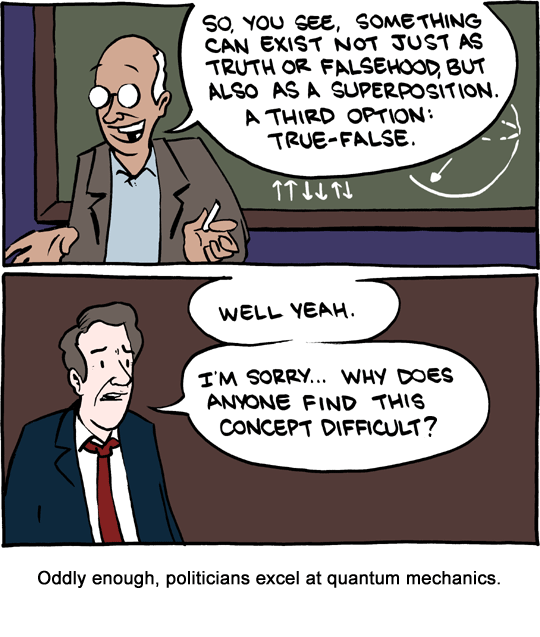
The Copenhagen interpretation of quantum mechanics does not mean that "nothing really exists" until we measure it. It just means that there is a superposition of quantum states, and then observation of a system causes a "collapse" of the wavefunction to give you a particular value for the measured quantity. Einstein, Podolsky and Rosen, whose 1935 paper was what Bell's 1964 paper responded to, also believed that there
was an objective, exact reality, and that we just couldn't see it. Bell's theorem and the related tests prove that this is not the case - even in principle, there is no such thing as a definite location and velocity for a particle.