

Words that mean the opposite
Moderator: Community Team
Forum rules
Please read the Community Guidelines before posting.
Please read the Community Guidelines before posting.

Words that mean the opposite
Espresso means "quick in time" yet its a much slower coffee than drip coffee that is premade at McDonald's.
░▒▒▓▓▓▒▒░
-
Thorthoth
- Posts: 3273
- Joined: Mon Dec 26, 2011 1:36 pm
- Location: My pyramid in Asgard, beside the glaciated Nile.
Re: Words that mean the opposite
A 'pre-made' espresso would be just as fast.DoomYoshi wrote:Espresso means "quick in time" yet its a much slower coffee than drip coffee that is premade at McDonald's.
I recommend making a whole pot of drip coffee and keeping it in the refrigerator. It stays perfectly fresh for several days. Just reheat it in the microwave.
THORTHOTHORTHOTHORTHOTHORTHOTHORTHOTHORTHOTHORTHOTHORTHOTHORTHOTH
- Click image to enlarge.

-
tzor
- Posts: 4051
- Joined: Thu Feb 22, 2007 9:43 pm
- Gender: Male
- Location: Long Island, NY, USA
- Contact:
Re: Words that mean the opposite
Uh no. Wrong. The actual meaning is "pressed out" and the coffee part is assumed. The correct term is "caffè espresso."DoomYoshi wrote:Espresso means "quick in time" yet its a much slower coffee than drip coffee that is premade at McDonald's.
Perhaps you are confusing the term presto?



Re: Words that mean the opposite
"Very funny" means extremely humorous, and yet it's used as the title for emails that are deathly dull and utterly devoid of humour.
“Life is a shipwreck, but we must not forget to sing in the lifeboats.”
― Voltaire
― Voltaire

Re: Words that mean the opposite
From Wikipedia:tzor wrote:Uh no. Wrong. The actual meaning is "pressed out" and the coffee part is assumed. The correct term is "caffè espresso."DoomYoshi wrote:Espresso means "quick in time" yet its a much slower coffee than drip coffee that is premade at McDonald's.
Perhaps you are confusing the term presto?
Although some Anglo-American dictionaries simply refer to "pressed-out",[18] "espresso," much like the English word "express", conveys the senses of "just for you" and "quickly," which can be related to the method of espresso preparation.
The words express, expres and espresso each have several meanings in English, French and Italian. The first meaning is to do with the idea of "expressing" or squeezing the flavour from the coffee using the pressure of the steam. The second meaning is to do with speed, as in a train. Finally there is the notion of doing something "expressly" for a person ... The first Bezzera and Pavoni espresso machines in 1906 took 45 seconds to make a cup of coffee, one at a time, expressly for you.[19]
Another source, the Online Etymology Dictionary, favors the "pressed out" explanation: "coffee made under steam pressure, 1945, from Italian (caffe) espresso, from espresso 'pressed out,' past participle of esprimere, from Latin exprimere 'press out, squeeze out' ... [, i]n reference to the steam pressure."[20]
Modern espresso, using hot water under pressure, as pioneered by Gaggia in the 1940s, was originally called crema caffè, in English "cream coffee", as can be seen on old Gaggia machines, due to the crema.[21] This term is no longer used, though crema caffè and variants (caffè crema, café crema) find occasional use in branding.
░▒▒▓▓▓▒▒░

Re: Words that mean the opposite
Fishing- drinking beer not catching fish.
Parkway- something you drive on
Driveway- something you park on
By the way, coffee makes me fart, how bout you?
Parkway- something you drive on
Driveway- something you park on
By the way, coffee makes me fart, how bout you?
-
jonesthecurl
- Posts: 4660
- Joined: Sun Mar 16, 2008 9:42 am
- Gender: Male
- Location: disused action figure warehouse
- Contact:
Re: Words that mean the opposite
raised/razed
flammable/inflammable
flammable/inflammable
instagram.com/garethjohnjoneswrites
-
Thorthoth
- Posts: 3273
- Joined: Mon Dec 26, 2011 1:36 pm
- Location: My pyramid in Asgard, beside the glaciated Nile.
Re: Words that mean the opposite
Yes Jones, the subject of contranyms is a most serious one.
Are these terms mere linguistic quirks or are they the harbingers of communicative disintegration?
Wikipedia's list needs some reorganization but it is a very good list to start with.
https://en.wiktionary.org/wiki/Appendix ... contranyms
Are these terms mere linguistic quirks or are they the harbingers of communicative disintegration?
Wikipedia's list needs some reorganization but it is a very good list to start with.
https://en.wiktionary.org/wiki/Appendix ... contranyms
THORTHOTHORTHOTHORTHOTHORTHOTHORTHOTHORTHOTHORTHOTHORTHOTHORTHOTH
- Click image to enlarge.
Re: Words that mean the opposite
I don't think this qualifies:Thorthoth wrote:Yes Jones, the subject of contranyms is a most serious one.
Are these terms mere linguistic quirks or are they the harbingers of communicative disintegration?
Wikipedia's list needs some reorganization but it is a very good list to start with.
https://en.wiktionary.org/wiki/Appendix ... contranyms
oral/aural
pertaining to speech / pertaining to hearing
People only speak to be heard. Oral and Aural should be treated as symbionyms, not contranyms.
“Life is a shipwreck, but we must not forget to sing in the lifeboats.”
― Voltaire
― Voltaire
Re: Words that mean the opposite
logic of the english language:
Oxford dictionaries wrote:valuable
1Worth a great deal of money.
1.1 Extremely useful or important.
invaluable
Extremely useful; indispensable.
-
Thorthoth
- Posts: 3273
- Joined: Mon Dec 26, 2011 1:36 pm
- Location: My pyramid in Asgard, beside the glaciated Nile.
Re: Words that mean the opposite
That case isn't a contranym. You're get the prefixes 'in/im' and 'un' confused.waauw wrote:logic of the english language:
Oxford dictionaries wrote:valuable
1Worth a great deal of money.
1.1 Extremely useful or important.
invaluable
Extremely useful; indispensable.
THORTHOTHORTHOTHORTHOTHORTHOTHORTHOTHORTHOTHORTHOTHORTHOTHORTHOTH
- Click image to enlarge.
Re: Words that mean the opposite
No, it's not a contranym, which is exactly my point. And 'in/im' has the same meaning as 'un'.Thorthoth wrote:That case isn't a contranym. You're get the prefixes 'in/im' and 'un' confused.waauw wrote:logic of the english language:
Oxford dictionaries wrote:valuable
1Worth a great deal of money.
1.1 Extremely useful or important.
invaluable
Extremely useful; indispensable.
-
jonesthecurl
- Posts: 4660
- Joined: Sun Mar 16, 2008 9:42 am
- Gender: Male
- Location: disused action figure warehouse
- Contact:

Re: Words that mean the opposite
There are plenty that I like that changed meanings-
"Dreadful"- used to mean inspired "dread", now means almost the opposite- something terrible which leads me to...
"Terrible"- used to mean inspiring terror, now just means something bad.
Some phrases have come to mean the same thing- "I could care less" and "I couldn't care less" mean the same thing, for example.
"Dreadful"- used to mean inspired "dread", now means almost the opposite- something terrible which leads me to...
"Terrible"- used to mean inspiring terror, now just means something bad.
Some phrases have come to mean the same thing- "I could care less" and "I couldn't care less" mean the same thing, for example.
the world is in greater peril from those who tolerate or encourage evil than from those who actually commit it- Albert Einstein
Re: Words that mean the opposite
DoomYoshi wrote:
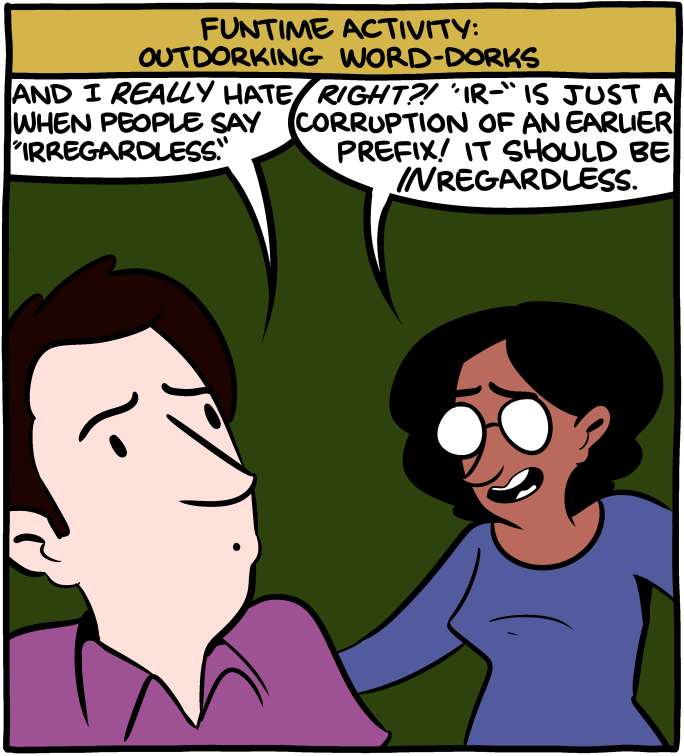
"I really hate" when the phrase means that he doesn't?
the world is in greater peril from those who tolerate or encourage evil than from those who actually commit it- Albert Einstein
Re: Words that mean the opposite
I like ambiguity.
For one thing, it really makes Alanis Morissette's ability to craft a song about irony run rings about Dukasaur even at the most basic level.
For one thing, it really makes Alanis Morissette's ability to craft a song about irony run rings about Dukasaur even at the most basic level.
the world is in greater peril from those who tolerate or encourage evil than from those who actually commit it- Albert Einstein
-
Thorthoth
- Posts: 3273
- Joined: Mon Dec 26, 2011 1:36 pm
- Location: My pyramid in Asgard, beside the glaciated Nile.
Re: Words that mean the opposite
I f you really like ambiguity, then shut up before you start whining about your lates hurtful/hateful/iun-PC issue, you dorksucker.Symmetry wrote:I like ambiguity.
You're probably just misinterpreting it. In fact, it might even ambiguously mean the exact opposite of what you think it does.
Clearly many secondary contranymic definitions started out as sarcasm.
THORTHOTHORTHOTHORTHOTHORTHOTHORTHOTHORTHOTHORTHOTHORTHOTHORTHOTH
- Click image to enlarge.
Re: Words that mean the opposite
Nice try.Thorthoth wrote:I f you really like ambiguity, then shut up before you start whining about your lates hurtful/hateful/iun-PC issue, you dorksucker.Symmetry wrote:I like ambiguity.
You're probably just misinterpreting it. In fact, it might even ambiguously mean the exact opposite of what you think it does.
Clearly many secondary contranymic definitions started out as sarcasm.
the world is in greater peril from those who tolerate or encourage evil than from those who actually commit it- Albert Einstein
-
DirtyDishSoap

- Posts: 9383
- Joined: Mon Jan 15, 2007 7:42 pm
- Gender: Male
Re: Words that mean the opposite
Can we ever come to an agreement that Wikipedia is a poor source for information?
Cool.
Cool.
Dukasaur wrote:Your obsession with mrswdk is really sad.saxitoxin wrote:taking medical advice from this creature; a morbidly obese man who is 100% convinced he willed himself into becoming a woman.
ConfederateSS wrote:Just because people are idiots... Doesn't make them wrong.
-
jonesthecurl
- Posts: 4660
- Joined: Sun Mar 16, 2008 9:42 am
- Gender: Male
- Location: disused action figure warehouse
- Contact:
Re: Words that mean the opposite
"Virtual" used to mean "real". Now it means "not real".
"Nice" used to mean "thin".
"Sophisticated" used to mean "pretentious".
"Nice" used to mean "thin".
"Sophisticated" used to mean "pretentious".
instagram.com/garethjohnjoneswrites
Re: Words that mean the opposite
Symmetry wrote:I like ambiguity.
For one thing, it really makes Alanis Morissette's ability to craft a song about irony run rings about Dukasaur even at the most basic level.

You are an idiot. But the joke is good...

“Life is a shipwreck, but we must not forget to sing in the lifeboats.”
― Voltaire
― Voltaire
Re: Words that mean the opposite
It is what it is- an encyclopedia. A great source of information if you want to skim a subject. For anything controversial it's poor as a rule. Treat it as unreliable, is my general rule, and always look at the sources.DirtyDishSoap wrote:Can we ever come to an agreement that Wikipedia is a poor source for information?
Cool.
the world is in greater peril from those who tolerate or encourage evil than from those who actually commit it- Albert Einstein
Re: Words that mean the opposite
Admit it- you like her.Dukasaur wrote:Symmetry wrote:I like ambiguity.
For one thing, it really makes Alanis Morissette's ability to craft a song about irony run rings about Dukasaur even at the most basic level.
You are an idiot. But the joke is good...
the world is in greater peril from those who tolerate or encourage evil than from those who actually commit it- Albert Einstein